70% of the Web Exposed: Critical 'PHP2Shell' RCE Flaw Prompts Emergency Disconnects Across Europe
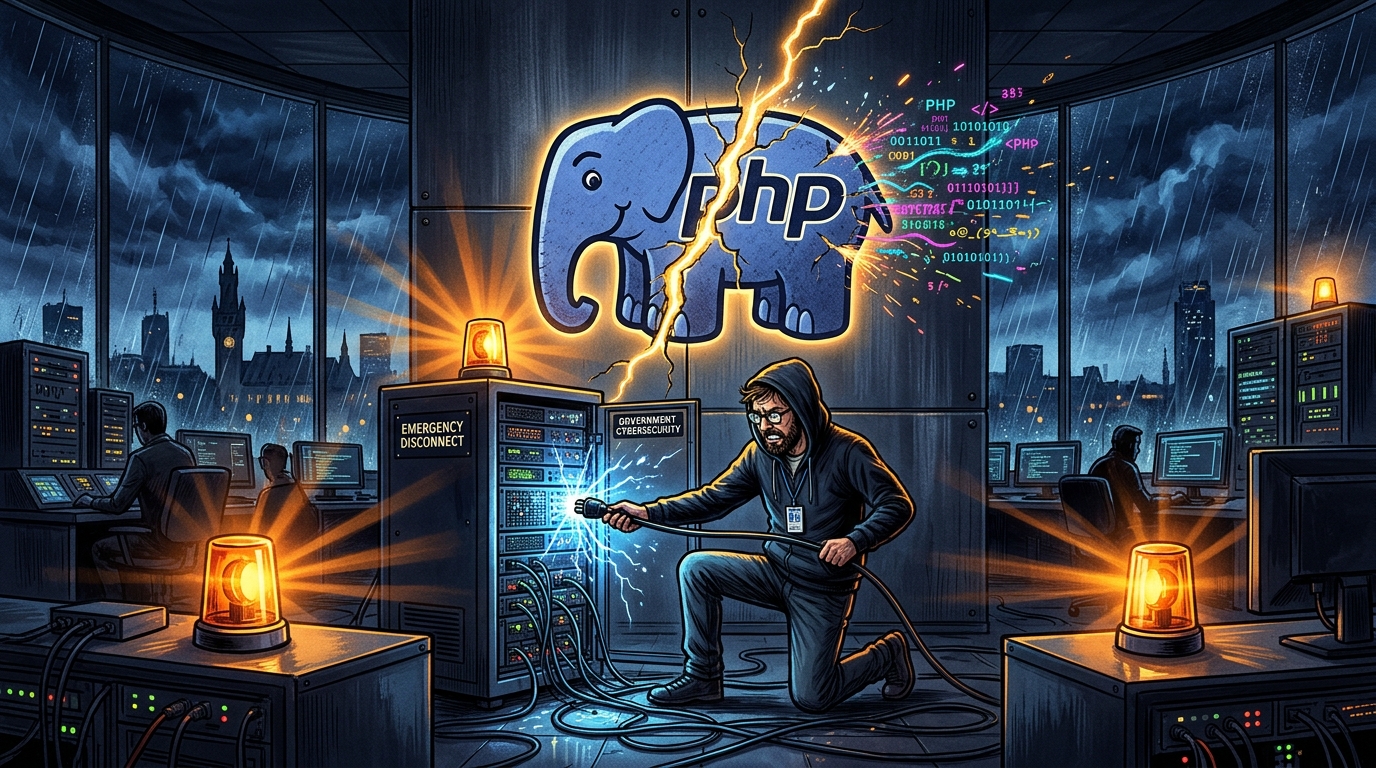
The PHP2Shell vulnerability exposes the fragile dependency beneath our modern digital economy: while the tech world obsesses over frontier models, 70% of dynamic websites still run on a thirty-year-old scripting engine. When a core unauthenticated RCE strikes, enterprise CI/CD pipelines can patch in hours, but hundreds of millions of abandoned End-of-Life servers will remain perpetual breeding grounds for cyber botnets. Technological debt always demands repayment.
At 3:00 AM, a senior site reliability engineer in Amsterdam was jolted awake by the shrill ring of an emergency escalation phone call. When he grabbed his laptop and established a VPN tunnel into the internal telemetry console, what appeared on his monitor banished all traces of sleep within seconds: the official public service portals for multiple Dutch and Finnish government ministries, maritime port logistics scheduling clusters, and several prestigious universities had simultaneously flipped to offline placeholder pages.
There had been no physical cruise missile strike launched by hostile nation-states, nor was it a conventional distributed denial-of-service (DDoS) flood overwhelming network ingress. Instead, national computer emergency response teams, spearheaded by the Dutch National Cyber Security Centre (NCSC-NL) and Finland's Valtori digital agency, had issued an urgent operational directive. Because underground weaponized exploit frameworks had begun leaking across private hacker message boards, critical infrastructure operators across Northern Europe were forced to execute the most primitive, yet most effective defensive protocol: precautionary physical network disconnects.
The seismic cybersecurity shockwave rolling across global digital infrastructure has been designated by security analysts as "PHP2Shell".
It comprises a devastating pair of tightly coupled sibling flaws—cataloged under CVE-2026-109618 and CVE-2026-109619—carrying a chilling Common Vulnerability Scoring System (CVSS v4.0) score of 9.2 (Unauthenticated Remote Code Execution). After reproducing and reverse-engineering the flaw, threat research laboratories worldwide arrived at an identical, sobering conclusion: this is the most critical penetrative vulnerability discovered in the foundational architecture of the modern dynamic web in over a decade.
Who Would Have Thought Modern 2026 Tech Would Stumble Over a Thirty-Year-Old Legacy Engine
Within programmer communities, the phrase "PHP is the best programming language in the world" spent two decades circulating as a self-deprecating developer joke.
In today's glittering tech narrative dominated by frontier generative AI models, microservices, containerization, and serverless edge computing, many junior developers mistakenly assumed this thirty-year-old scripting language born in 1995 had long since been relegated to the digital museum. Reality, however, delivered a brutal awakening with unforgiving statistical facts: According to global web infrastructure telemetry from W3Techs, between 69.4% and 70% of all websites whose server-side programming languages are publicly verifiable remain solidly anchored to PHP.
From WordPress and WooCommerce powering over forty percent of modern storefronts, to Drupal and Joomla installations serving European government agencies and university faculties for over a decade, all the way to Magento and Laravel stacks underpinning countless cross-border e-commerce platforms. Every single time a citizen taps a smartphone screen to submit an official visa application, places an order on an independent boutique shop, or enrolls in college semester classes, the underlying server engine parsing the HTTP payload is overwhelmingly likely to be that familiar blue PHP elephant.
What makes "PHP2Shell" an existential threat to internet security is that the poison was not planted within some obscure third-party open-source plugin or flawed application business logic, but directly inside the beating heart of the core C-based PHP interpreter itself. This means that regardless of how defensively clean your application architecture is written, and regardless of how many layers of SQL parameterization and sanitization your engineers configured, if your runtime sits on an unpatched PHP engine, the foundation beneath your skyscraper has already been blown wide open.
Zero Credentials Required: How a Single Malformed HTTP Request Puppeteers the Entire PHP Process
To appreciate the sheer severity of this vulnerability, one must examine the precise memory corruption chain that allows an unauthorized attacker to seize complete root execution without needing a single username, password, or session cookie:
1. Memory Cleavage Triggered by Fatal Out-of-Memory Errors (CVE-2026-109618: OOM-Induced UAF):
Under typical execution conditions, when the PHP engine encounters an irrecoverable fatal error such as an Out-of-Memory (OOM) ceiling breach, the low-level C codebase executes a violent longjmp() abort to unwind the call stack out of the active context. During this abrupt abort sequence, memory data structures allocated for the active HTTP request have only been partially initialized. When the subsequent global cleanup handler attempts to deallocate request resources, it treats uninitialized garbage memory offsets as valid heap pointers, instantaneously triggering a critical Use-After-Free (UAF) condition. An adversary simply needs to transmit an engineered payload that deliberately exhausts available memory limits, allowing them to precisely spray executable jump instructions into hijacked memory space;
2. Ghost Global State Persisting Across Worker Recycling (CVE-2026-109619: Stale Global State):
The second sibling flaw makes the attack vector significantly more sinister. In modern high-throughput php-fpm architectures, individual worker processes are continuously reused to service tens of thousands of consecutive HTTP transactions to avoid process spawning overhead. When a preceding request crashes violently due to a fatal OOM condition, internal global state pointers and request-scoped session structures are not thoroughly purged from the worker thread stack, lingering like a ghost within the process heap. When the subsequent inbound web request arrives at that recycled worker, any interaction with that unzeroed memory before full state reset induces catastrophic Type Confusion, granting remote hackers direct puppeteering control over execution privileges.
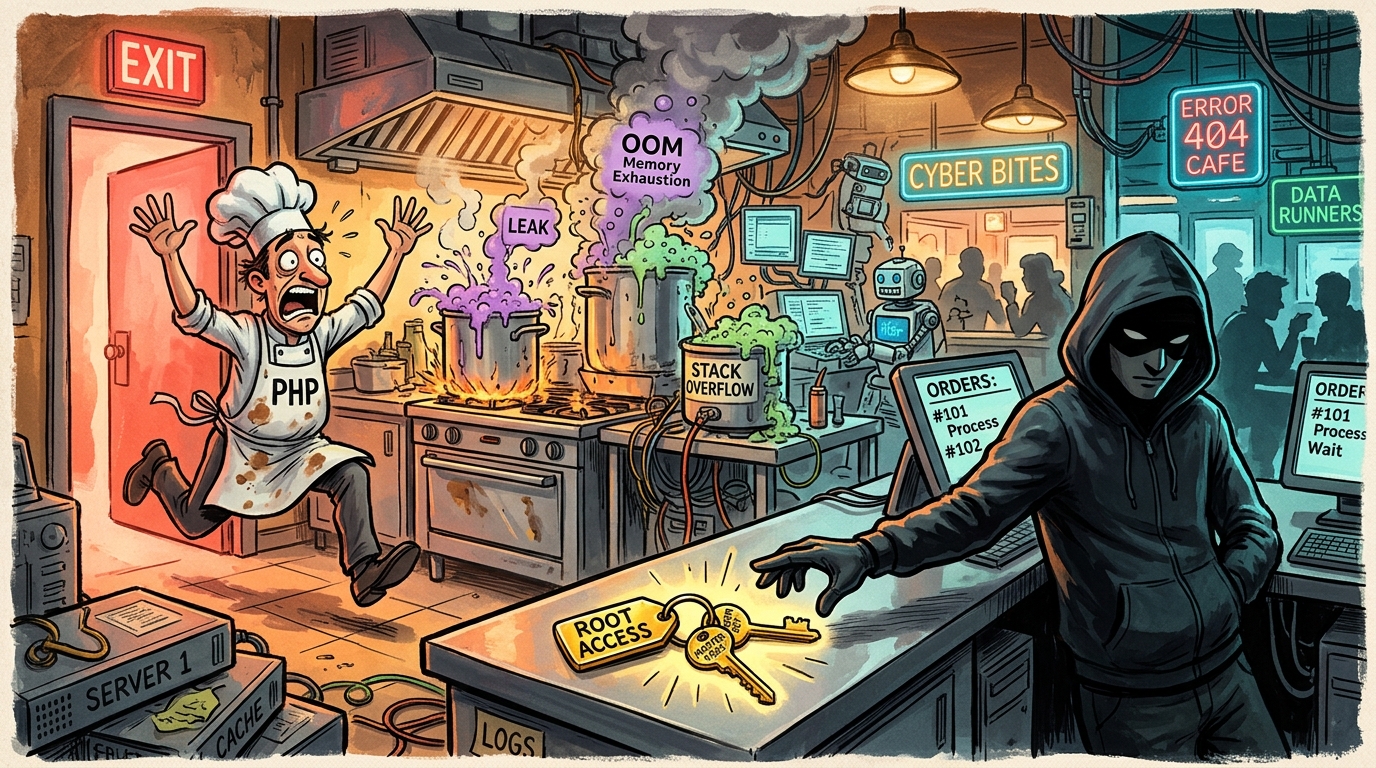
To use an intuitive real-world culinary analogy: imagine the open kitchen of a frantic rush-hour restaurant where the head chef collapses from heat exhaustion and bolts through the back alley door after a malicious patron places an impossibly massive fake order. But in his panicked flight, the chef leaves the kitchen doors unlocked and carelessly tosses his apron—along with the master keys to the bank vault and the main electrical breaker—right onto the smoking stovetop. The very next customer stepping through the front door does not even need to read the menu; they simply walk behind the counter and take legal ownership of the entire building.
European Governments Pull the Physical Plug: When Cyber War Hits Reality, Cutting the Cable Is the Cleanest Defense
Had this vulnerability remained confined to theoretical academic papers presented at private white-hat security conferences, global incident responders would not have entered a state of emergency.
The match that ignited national defense protocols across Europe and North America was the fact that weaponized exploit proof-of-concept (PoC) scripts leaked onto underground illicit hacking channels before upstream security patches could be uniformly deployed across production clusters.
Within mere hours, automated scanning engines throughout private threat networks had integrated the exploit signature, unleashing a torrential downpour of reconnaissance probes targeting public IP ranges across the European continent. Confronted with a lethal vulnerability requiring zero authentication where open ports meant instant server compromise, the Dutch National Cyber Security Centre (NCSC-NL) and the Finnish State IT agency Valtori made a command decision rarely observed in peacetime administration:
Directing subordinate civic portals, public healthcare registries, university research databases, and maritime freight scheduling extranets to execute precautionary operational network blackouts until validation of security patches could be completed.
In highly digitized Nordic and Western European economies, a government officially shutting down public online infrastructure is the civil defense equivalent of sounding air raid sirens and declaring an emergency blackout curfew. This unprecedented move toward physical cable disconnection laid bare the staggering, fragile dependency modern civilization maintains on decades-old open-source code repositories.
The Cruelest Internet Fault Line: Official Patches Are Live, but Hundreds of Millions of Legacy Servers Sit Abandoned

Although the international PHP core security maintainers moved with commendable agility to roll out emergency point releases across supported branches on October 21, veteran systems engineers recognize that the true security crisis has only just begun:
The modern web is fractured along a brutal maintenance fault line that will haunt internet infrastructure for years:
1. Official Patches Only Protect Actively Maintained Runtimes (PHP 8.2+): Upstream maintainers exclusively backported emergency security remediations to the four officially supported branches: PHP 8.2.35, PHP 8.3.36, PHP 8.4.27, and the newly minted PHP 8.5.12 release. Hyperscale cloud providers, modern SaaS platforms, and enterprise hosting facilities can deploy these rolling updates across production clusters via automated CI/CD pipelines within a couple of business days; 2. Hundreds of Millions of Legacy Servers Become Incubators for Cyber Zombie Armies: Over half of all PHP servers active on the public internet remain anchored to abandoned End-of-Life (EOL) releases—such as PHP 7.4, PHP 7.2, and prehistoric PHP 5.6 installations. These abandoned instances belong to European trading businesses that shuttered five years ago, municipal water district billing lookup tools that haven't been touched in a decade, or forgotten personal blogs hosted on cheap virtual private servers. Upstream maintainers will never release official patches for these abandoned versions, and autonomous internet worms will spend the coming months systematically transforming these tens of millions of unprotected hosts into sprawling botnet armies.
The Survival Action Checklist for Webmasters and Developers: Three Steps to Fortify Your Perimeter
If your organization manages any internet-facing endpoint running dynamic PHP scripts, or if your operational stack relies on platforms like WordPress, WooCommerce, Drupal, or Laravel, suspend all non-essential roadmaps immediately and execute this survival checklist:
1. Step One: Verify Your True Production Engine Runtime Immediately:
Never rely blindly on cloud control panels or administrative dashboards; log directly into your production host shell and inspect the real binary by running:
``bash
php -v
`
If your server reports a release within the 8.2.x line below 8.2.35, 8.3.x below 8.3.36, 8.4.x below 8.4.27, or 8.5.x below 8.5.12, immediately pull the latest hardened packages from official distribution repositories, and ensure both php-fpm` and your frontline web server processes are restarted to activate patched binaries;
2. Step Two: Emergency Mitigation Pathways for Unsupported Legacy Runtimes (PHP 7.x/8.1):
If deep legacy business dependencies make immediate migration to PHP 8.2+ technically impossible, check your enterprise operating system distribution streams (such as Ubuntu ESM or commercial enterprise backport channels) for vendor-curated hotfixes. In the complete absence of vendor maintenance, immediately restrict management interfaces to corporate IP access lists or terminate public ingress behind an encrypted corporate VPN gateway;
3. Step Three: Deep Perimeter Hardening at the WAF and Reverse Proxy Tier:
Configure strict request size ceilings and payload inspection rules on reverse proxy boundaries like Nginx, HAProxy, and Cloudflare WAF. Immediately drop inbound HTTP transactions exhibiting anomalous Content-Length values, heavily nested multipart structures, or oversized POST bodies, thereby severing the initial exploit payload before it can trigger an Out-of-Memory condition within the underlying runtime engine.
The global detonation of "PHP2Shell" serves as a jarring wake-up call to an industry captivated by generative AI breakthroughs: the glittering skyscrapers of modern cloud civilization may touch the stars, but if a thirty-year-old rusted nail buried deep in the bedrock gives way, the entire digital metropolis can still be shaken to its core in an instant.