OpenAI Launched a New Agent Named Dots: Rushed Branding Left the Domains in Musk's Hands
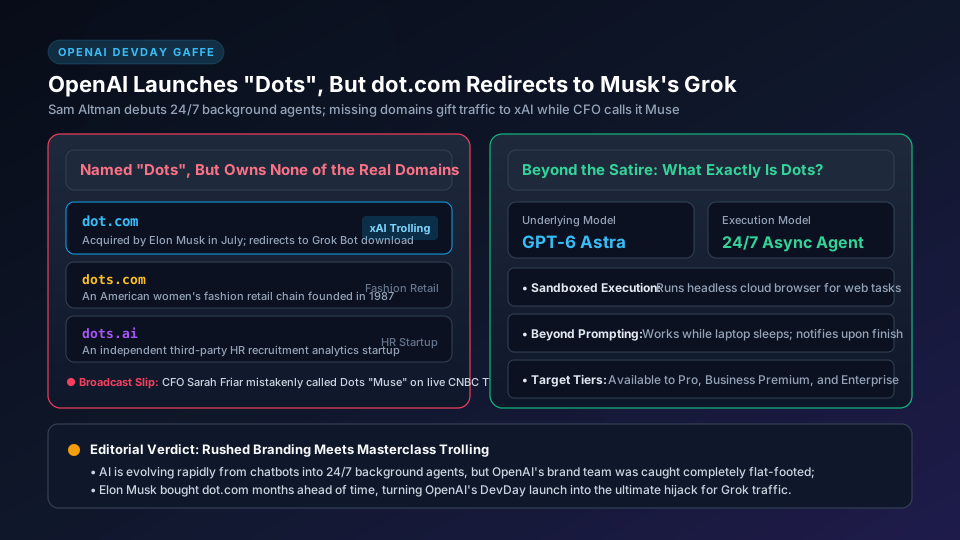
OpenAI unveiled its 24/7 background agent Dots powered by GPT-6 Astra, only to suffer a comedy of errors including Musk's 301 redirect on dot.com, an apparel store mix-up, and an on-air slip by its CFO; yet underneath the noise, asynchronous autonomous execution signals a new phase for AI enterprise labor.
# OpenAI Launched a New Agent Named Dots: Rushed Branding Left the Domains in Musk's Hands
If you have been looking for entertainment across the tech industry over the past few days, OpenAI's latest public spectacle is an absolute masterclass in corporate slapstick.
At the recently concluded autumn DevDay keynote, Sam Altman took the stage with unbridled confidence to unveil OpenAI's long-anticipated flagship breakthrough: Dots.
According to the official pitch, this is no longer another half-baked conversational chat box waiting for you to feed it prompts one line at a time. Instead, it is an "autonomous 24/7 background agent" powered directly by the underlying GPT-6 Astra architecture. It arrives equipped with a dedicated headless cloud browser, deeply integrated connections across more than 4,000 enterprise applications, and the ability to execute tasks asynchronously. You can shut your laptop, go to sleep, and let it autonomously scrape data, reconcile supplier agreements, and book flights directly in the cloud.
The underlying engineering is genuinely impressive. Yet nobody anticipated that within barely two hours of the keynote wrapping up, internet onlookers searching for the new product would trigger one of the most absurd domain brawls and live television trainwrecks in modern corporate history.
When a multi-hundred-billion-dollar tech powerhouse launches a category-defining product, the primary threat is rarely rival benchmarks. It is the legal department sleeping on the job, the core domains falling into the hands of bitter rivals, and the chief financial officer going on live national television to accidentally praise a competitor.
---
Key Takeaways and Ground Truth: Engineering Accelerates While Legal and PR Sleepwalk
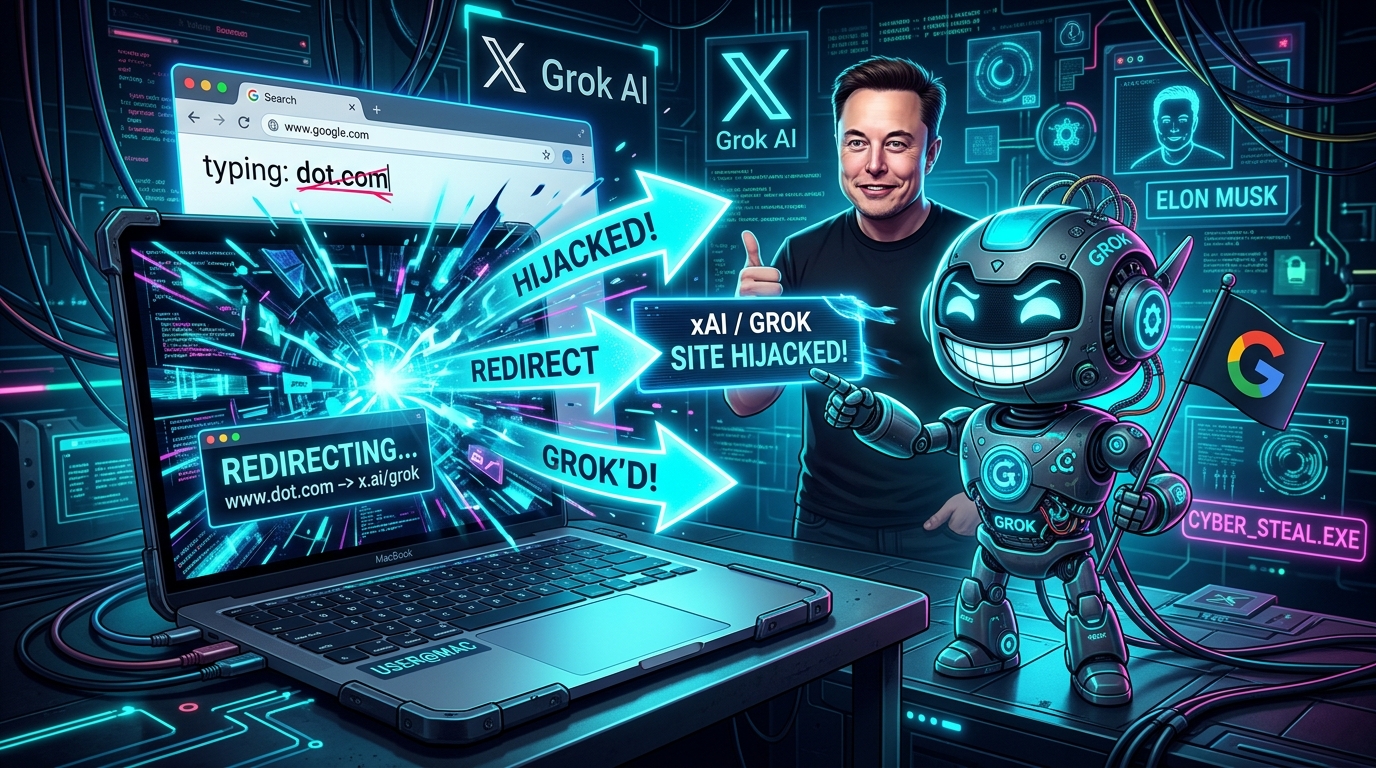
Just how bizarre did the rollout get in real time? Let us examine the three hardest, verifiable facts from the ground:
- The First Blow (Musk's Flawless Ambush): Millions of curious developers hearing the name Dots instinctively opened their browser and typed
dot.comto find the official website. The moment they hit Enter, an HTTP 301 permanent redirect aggressively intercepted their traffic and dumped them straight onto the download portal for Elon Musk's rival Grok assistant. Musk had quietly acquired the premium domain back in July, patiently waiting for this exact ambush opportunity. - The Second Labyrinth (Every Primary Domain Lost): Wondering if the singular was a typo, users tried typing the plural
dots.com. Instead of neural network diagrams, they landed on an American discount retail women's clothing chain founded in 1987, running a clearance sale on floral polyester dresses. Those pivoting todots.aiwere greeted by an unrelated HR recruitment startup whose infrastructure crashed under the sudden wave of confused AI refugees. - The Third Crash (CFO Endorses Meta on Live Television): OpenAI Chief Financial Officer Sarah Friar joined a live CNBC prime-time broadcast to pitch the commercial potential of Dots. While explaining enterprise automation, she slipped on air: "Our new agent Muse... sorry, I mean Dots!" Unfortunately for OpenAI, "Muse" is the exact name of Mark Zuckerberg's competing agent suite released only weeks earlier by Meta.
The faster the technological deployment moved, the louder the operational slap in the face sounded. While OpenAI's latest product genuinely reflects the architectural shift from passive chat interfaces toward autonomous digital workers, its branding hygiene and defensive infrastructure delivered a textbook case study in organizational chaos.
---
The Great Domain Brawl: Everyone Owns Dots Except OpenAI
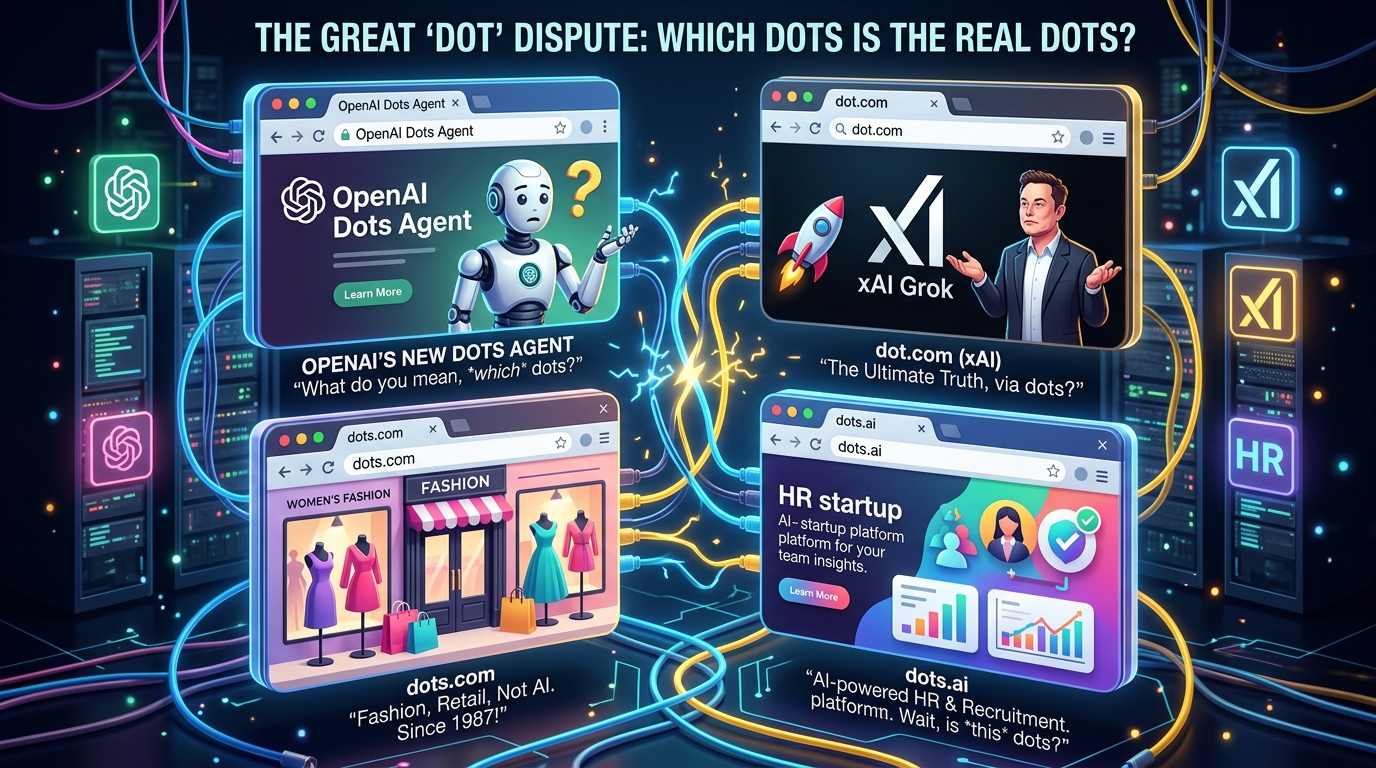
Every experienced product builder across consumer internet and enterprise software understands a fundamental survival law: before an initiative sees public daylight, lock down every associated domain name regardless of acquisition cost.
Yet OpenAI appeared swept away by its relentless shipping velocity. Once the code name "Dots" was thrust into the international spotlight, observers quickly realized that OpenAI's branding and legal departments had left their core perimeter completely undefended:
1. dot.com Turned into Elon Musk's Bear Trap:
The hostility between Elon Musk and OpenAI is public knowledge, spanning bitter lawsuits over commercial restructuring to xAI's direct competition against GPT models. When Musk purchased the ultra-rare dictionary domain dot.com earlier this summer, industry observers assumed it was destined for some experimental feature within the X platform. Instead, the moment DevDay concluded, Musk's team configured an immediate redirect ensuring that all curious traffic hitting dot.com went straight to xAI's Grok. OpenAI spent millions orchestrating a global developer conference, only for its fiercest antagonist to harvest the resulting search momentum for free.
2. dots.com Was Busy Selling Discount Cardigans:
Visitors who deliberately entered the exact plural form dots.com were met with utter confusion. Instead of sleek dark-mode interfaces, interactive terminal consoles, or generative workflows, the screen displayed "Autumn Clearance Specials" alongside photographs of women's apparel on plastic hangers. This legacy American retail brand, which registered its web domain back in 1987, had navigated bankruptcies and corporate restructuring over nearly four decades, never dreaming that in the autumn of 2026 millions of software engineers would suddenly crash its online catalog.
3. dots.ai Became a Baffled HR Tech Startup:
Within the artificial intelligence ecosystem, teams unable to secure a dot-com registry routinely settle for a .ai top-level domain. Yet navigating to dots.ai led straight to a boutique startup specializing in internal corporate skills mapping and talent acquisition. The company's founder took to social media that afternoon with mixed amusement and exhaustion, reporting that their customer support queue had been flooded by thousands of urgent tickets asking how to resolve GPT-6 billing errors rather than hiring software developers.
Where did the actual OpenAI Dots live? It was relegated to lengthy internal subdomains and obscure application routing paths. For an enterprise valued at hundreds of billions of dollars striving to establish the universal operating interface of the intelligence era, surrendering its foundational naming perimeter carried an undeniable atmosphere of amateur execution.
---
Live Television Meltdown: The CFO Plugs Meta's Muse on National Broadcast
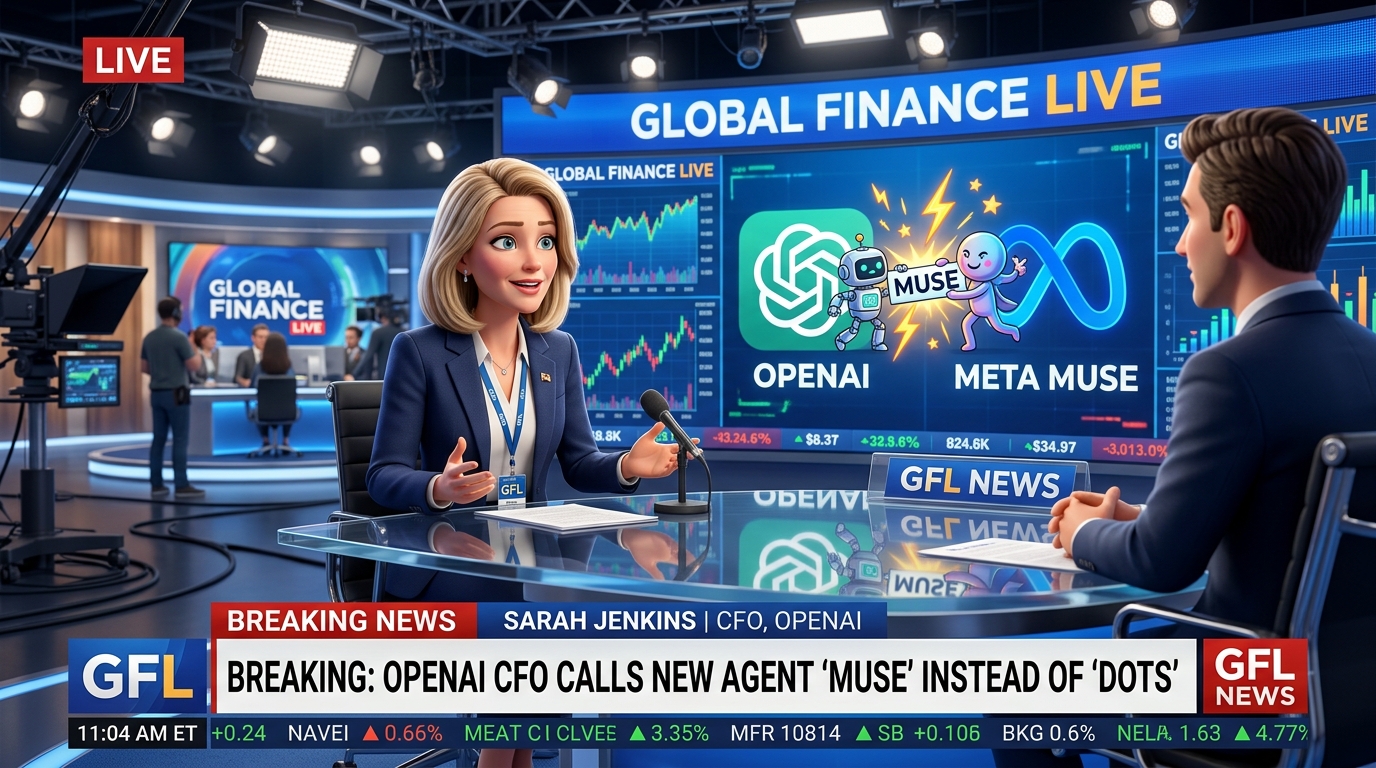
While losing domain real estate could theoretically be blamed on trademark collisions or Elon Musk's mischief, executive improvisation during a nationwide financial broadcast elevated the situation into unadulterated comedy.
Barely hours after OpenAI formally unveiled Dots, Chief Financial Officer Sarah Friar appeared as the senior organizational representative for a live satellite interview on CNBC.
The anchor posed a straightforward business question regarding monetization: "How does OpenAI plan to convince enterprise clients to pay premium subscription rates for autonomous background execution?"
Maintaining perfect posture and professional poise, Friar looked directly into the camera lens and answered:
"Enterprise customers have consistently demanded higher-order workflow automation. Our brand new agent Muse... sorry, I mean Dots, will fundamentally transform how organizations structure their operational throughput."
Although Friar corrected her terminology within half a second, the clip was extracted, edited, and distributed across social feeds within minutes, accumulating millions of views before the broadcast hour concluded.
Why did that single misplaced syllable carry such devastating comedic weight?
Just weeks prior, Mark Zuckerberg had hosted Meta's developer summit, prominently headlining their new enterprise collaboration suite under the brand name Muse. For OpenAI's primary financial steward—the individual managing multi-billion-dollar infrastructure outlays and competitive resource allocation—to endorse the direct rival's flagship product on national television revealed the intense pressure coursing through Silicon Valley.
Comment sections erupted with amusement, noting that even senior OpenAI leadership appeared to have Meta strategy meetings running continuously in their heads. The incident highlighted not only how frantic the race toward autonomous agents has become, but also how thoroughly the major labs have exhausted the English dictionary in their desperate rush to claim descriptive product names.
---
Stripping Away the Comedy: What Actually Is Dots Under the Hood?
Once the laughter subsides and the public relations blunders are set aside, one core question remains: does the technology underpinning Dots represent a meaningful leap forward?
The definitive assessment is: yes, because the functional paradigm has genuinely shifted.
Traditional workflows across ChatGPT, Claude, and Gemini have remained locked within synchronous conversational exchanges. You provide an instruction, wait at your desk while tokens stream onto the display, and risk stalling the entire job if your network connection drops or you shut your laptop.
Dots represents OpenAI's initial serious effort to deliver asynchronous long-running execution as a polished enterprise capability:
- Powered by GPT-6 Astra: Rather than relying on standard conversational chat checkpoints, Dots utilizes the purpose-built GPT-6 Astra foundation. The model demonstrates marked gains in branch evaluation, self-healing exception handling, and persistent environmental context retention over prolonged operational cycles.
- Headless Cloud Virtualization: Every individual instance of Dots runs inside a containerized sandbox coupled with an isolated headless browser. Rather than exhausting local hardware memory or network bandwidth on client machines, the agent executes tasks continuously within OpenAI's server infrastructure.
- Liberation from Constant Human Babysitting: A user can issue a complex asynchronous directive: "Every morning at eight, scrape the product catalogs of these five competitors, cross-reference pricing changes against last week, assemble an analysis sheet, and draft an alert email to procurement if any item drops by ten percent." Once dispatched, the user can shut down their device. Dots manages retry logic and verification autonomously, eventually pushing a synthesized completion card to mobile notifications.
- 4,000+ Native Enterprise Connections: Leveraging deeper API standard protocols, Dots bypasses fragile manual plugin configurations, reading and writing directly across leading document suites, repository managers, and enterprise financial platforms.
OpenAI has deliberately gated access during initial deployment, reserving Dots exclusively for Pro (priced at 200 dollars monthly), Business, and Enterprise subscribers. This posture reflects both the immense computational demands of persistent background containers and the stringent containment policies necessary when granting autonomous agents elevated operational privileges.
---
Who Came Out Ahead, Who Paid the Price, and What to Monitor Next
Reviewing the entire sequence of events illustrates wildly diverging outcomes across Silicon Valley's competing camps:
- Elon Musk Scored an Effortless Triumph: Without allocating a single dollar of promotional capital, a calculated domain acquisition executed months in advance enabled xAI to siphon millions of high-intent enterprise visitors straight into Grok's funnel while poking his fiercest adversary.
- The American Retailer
dots.comExperienced Its Strangest Week: A conventional apparel store catering to regional shoppers was suddenly inundated by hundreds of thousands of international software engineers searching for neural network documentation. While few likely purchased polyester blouses, the incident generated the most surreal traffic spike in the company's thirty-nine-year operational journey. - OpenAI Faces Necessary Operational Housekeeping: Legal and branding divisions must determine whether spending tens of millions of dollars to consolidate scattered domain assets makes financial sense, while engineering teams scramble to prove that real-world enterprise utility can quickly overshadow television gaffes.
Over the coming quarter, discerning observers should prioritize two technical developments over superficial naming disputes:
First, the true operational cost of agent hallucinations during long runs: when an autonomous system operates unmonitored for twelve consecutive hours, any minor error early in an execution loop risks burning through API quotas or distributing unauthorized external communications. Managing this failure envelope represents the true threshold between an interesting experiment and a dependable enterprise tool.
Second, the escalating contest over multi-agent computing environments: from Google's Antigravity framework and Meta's Muse to Anthropic's Claude Code and OpenAI's Dots, the frontier has permanently moved beyond benchmark conversational fluency toward independent operational labor. The platform that delivers superior sandbox stability, autonomous self-correction, and dependable tool chaining will ultimately secure the foundation of next-generation computing.
---