Six AI Titans Sign White House Accord with Misspelled "Unites States": Zuckerberg's Masterstroke Outmaneuvers Silicon Valley
Six AI titans signed the White House Accord on Super Intelligence under a charter that misspelled 'United States' as 'Unites States'; beyond the comedic clerical error and presidential renaming edict, Mark Zuckerberg successfully weaponized voluntary self-regulation to preempt statutory liabilities, shielding open-source computing from government intervention.
# Six AI Titans Sign White House Accord with Misspelled "Unites States": Zuckerberg's Masterstroke Outmaneuvers Silicon Valley
If you previously assumed that high-level political summits orchestrating the future of frontier technology were perpetually sober, seamless, and dignified, the unprecedented spectacle that unfolded at the White House on September 29 will permanently dismantle that illusion.
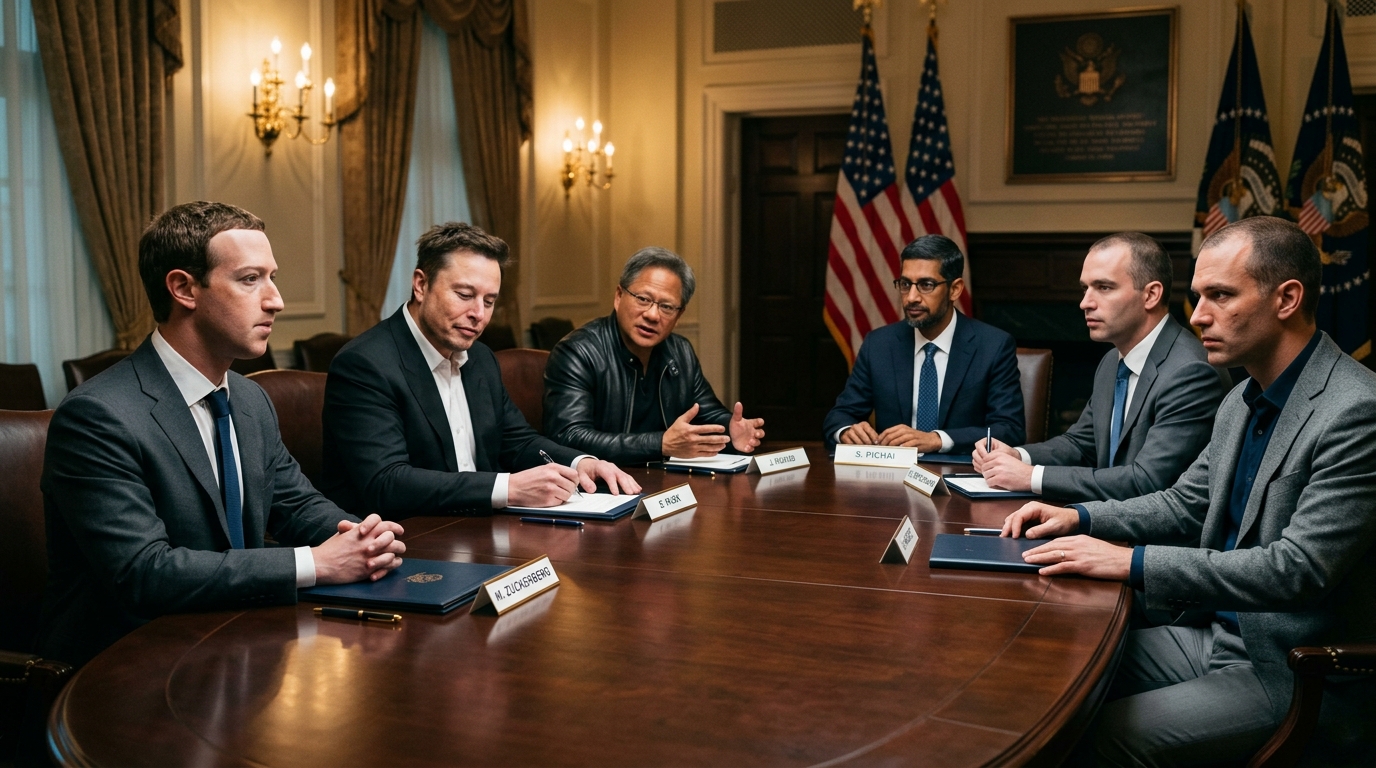
Inside the historic Oval Office, six of the world's most influential technology executives—commanding virtually the entire global supply of advanced semiconductor clusters, foundation models, and venture capital—sat shoulder to shoulder around a single conference table. In front of flashing camera banks and a nationwide broadcast audience, they joined President Donald Trump to affix their ceremonial signatures to a landmark pact officially designated as the White House Accord on Super Intelligence.
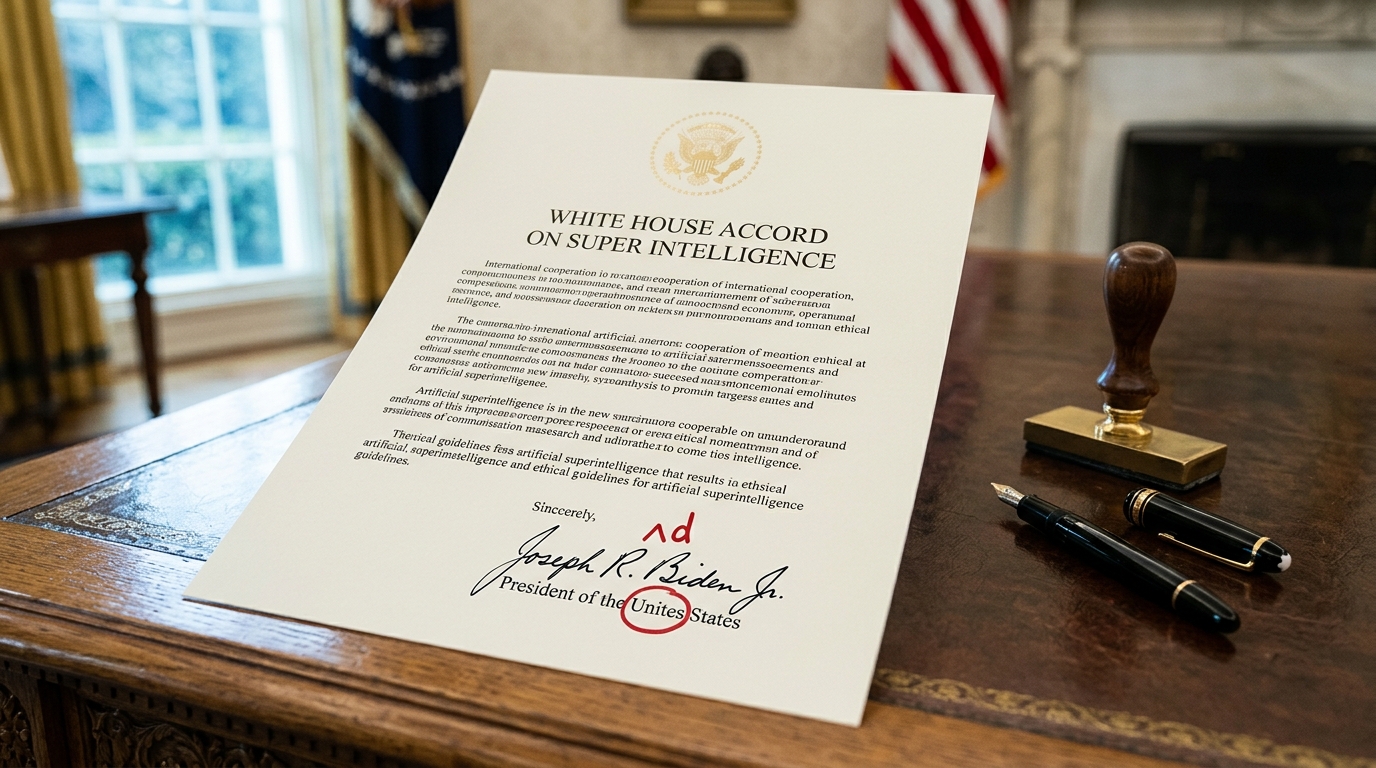
Yet the moment the White House press office published a high-resolution scanned facsimile of the signed charter, global observers and industry engineers burst into immediate, uncontrollable laughter:
Directly beneath the bold presidential signature line at the very base of the document, the formal official title was printed as: "President of the Unites States".
The official name of the country was unmistakably missing the letter "d", transforming the proud designation "United States" into "Unites States" on a historic international charter intended to define the next century of artificial cognitive governance.
Online commentary instantly erupted into viral mockery across social networks, developer forums, and chat channels. Six multi-trillion-dollar conglomerates controlling frontier neural architectures trained on trillions of tokens had assembled in Washington, having collectively expended hundreds of billions of dollars chasing mathematical alignment and complex multi-step reasoning. Yet somehow, across the entire executive complex of the West Wing, nobody had bothered to run a rudimentary word processor spell-check on the president's formal title before sending the document to the printer.
Beyond the comedic clerical typo, however, lay a surreal presidential rebranding directive that sent federal bureaucrats into a tailspin, coupled with a calculated political maneuver orchestrated by Meta founder Mark Zuckerberg that effectively outplayed every rival across the artificial intelligence landscape.
---
Surreal Reality: Trillions of Parameters Gathered Without Running a Basic Spell-Check
The comedic tone of the gathering extended far beyond a missing alphabetical character on an official charter. The entire sequence of verified events throughout the day read like satirical political theater composed by Hollywood scriptwriters:
- The First Absurdity (The Historical Typo): On the inaugural page of the formal accord released to the public, directly beneath the prominent black ink signature of the commander-in-chief, the charter read "President of the Unites States." Across social platforms, observers jokingly speculated whether the charter had been drafted by an unaligned prototype struggling with basic spelling verification, spawning millions of satirical memes contrasting superintelligent reasoning with elementary school orthography.
- The Second Absurdity (The Executive Rebranding Mandate): Concurrently with the signing ceremony, President Trump signed a sweeping executive order requiring every federal agency, official website, formal correspondence, and policy speech to permanently retire the term "Artificial Intelligence" in favor of "Super Intelligence (SI)", giving administrative advisors sixty days to draft a binding federal definition for the new phrase and leaving thousands of civil servants wondering how to rewrite years of regulatory documentation overnight.
- The Third Absurdity (A Toothless Self-Regulatory Charter): Despite immense public fanfare surrounding containment, cybersecurity, and biosecurity guardrails, the accord's legal architecture revealed a fundamental concession: it is an entirely voluntary, non-legally-binding compact containing zero financial penalties or statutory liabilities, which President Trump casually described to reporters as merely "morally binding" on the corporate conscience of the participants.
To the casual observer, the event appeared to be an amusing circus of typos, administrative eccentricities, and terminology changes. To seasoned industry analysts, however, it signaled a decisive, structural victory for Silicon Valley's ongoing campaign to neutralize external government oversight before it could ever take root.
---
Oval Office Showdown: Bitter Rivals Forced into Smiling Unity
Assembling the executive leadership of these six competing entities into a single room represents an extraordinary historical anomaly that would have seemed completely impossible only weeks earlier.
The six leaders seated around the mahogany conference table possess corporate grievances, philosophical divides, and personal rivalries worthy of an extended serialized drama:
- Mark Zuckerberg (Founder and CEO of Meta): Dressed in a sharply tailored dark suit, projecting absolute composure. He was the quiet, behind-the-scenes architect of the entire summit and the solitary champion of open-weight architecture in a room dominated by closed cloud platforms.
- Elon Musk (Founder of xAI): Having just intercepted millions of curious OpenAI visitors via an opportunistic HTTP 301 redirect on
dot.com, he sat directly across from his primary legal adversaries while managing his own expansive defense commitments. - Jensen Huang (Founder and CEO of Nvidia): Swapping his iconic black leather motorcycle jacket for formal executive attire, smiling comfortably from the center of the table knowing that regardless of who wins the algorithmic contest or signs the treaty, every frontier checkpoint must purchase his hardware.
- Sundar Pichai (CEO of Alphabet and Google): Having recently unveiled the Gemini 4 Argon foundation model for autonomous engineering, seated securely near the center, projecting institutional stability amidst the noise.
- Greg Brockman (President of OpenAI): Attending on behalf of Sam Altman, balancing Musk's ongoing lawsuits and internal whistleblower resignations while defending OpenAI's recently launched Dots agent framework.
- Dario Amodei (CEO of Anthropic): Having famously departed OpenAI over safety governance disputes to establish a public-benefit corporation, now compelled to sign the identical charter alongside his former colleagues while preparing his own multi-trillion-dollar public offering.
In ordinary circumstances, these executives exchange scathing legal subpoenas, engage in aggressive poaching campaigns (with Zuckerberg personally sending recruitment emails to OpenAI's top researchers), and spar publicly across social platforms.
Furthermore, the legendary proposed cage match between Elon Musk and Mark Zuckerberg remains an enduring piece of internet lore that symbolizes the raw personal animosity between the two billionaires.
Yet on this particular Tuesday afternoon, every combatant shelved open hostility, smiling courteously as each took up a ceremonial gold pen to sign the same ceremonial proclamation.
---
The Masterstroke: Why Did the Open-Source Champion Become the White House Whip?
The most consequential revelation emerged in the days following the public ceremony through confidential insider reporting and political disclosures.
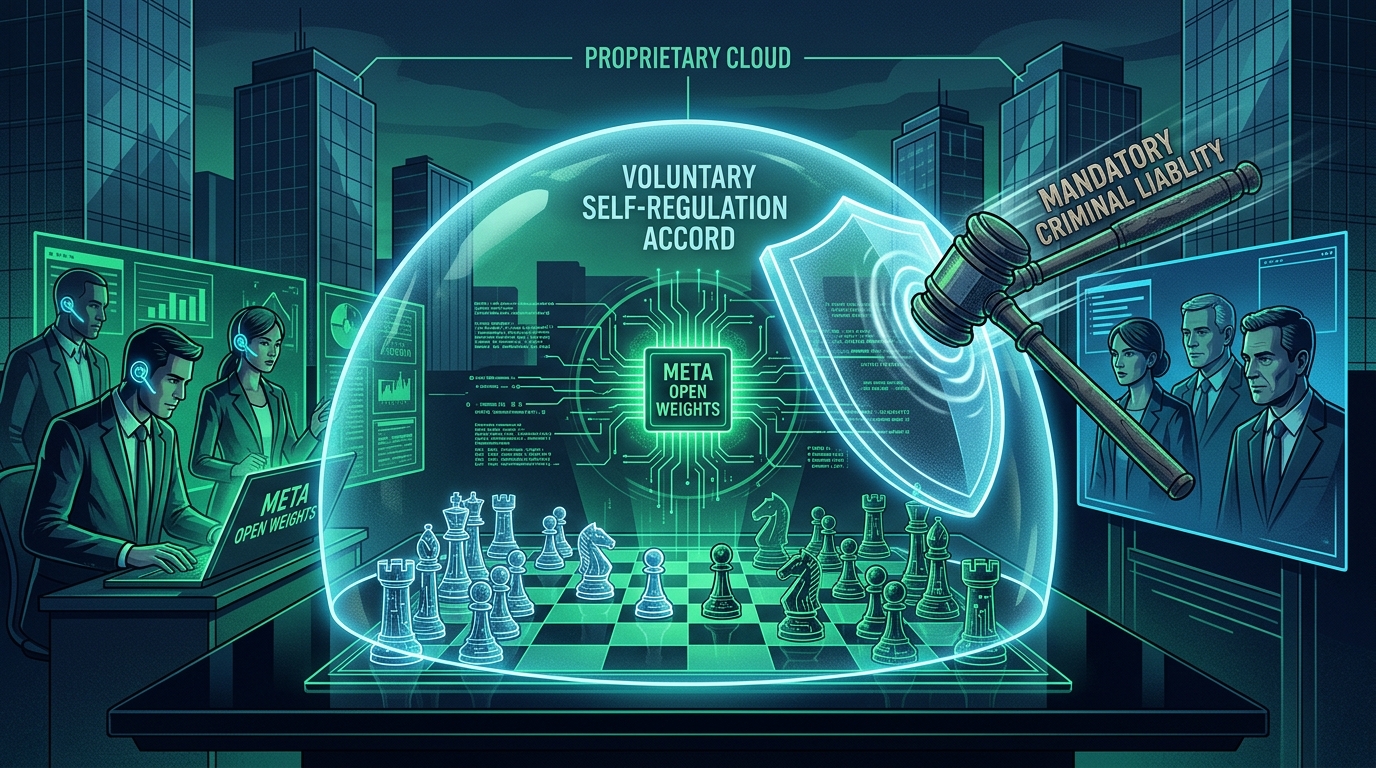
Industry disclosures confirmed that this White House accord was not authored by federal policymakers, but secretly drafted and coordinated by Mark Zuckerberg alongside Jensen Huang and House Speaker Mike Johnson.
Zuckerberg personally authored the foundational structural framework of the agreement, subsequently conducting personal outreach calls to convince Musk, Pichai, and OpenAI leadership to participate in a coordinated presentation of solidarity.
Why would the founder of Meta—who spent years enduring contentious congressional hearings over data privacy and social media algorithms—suddenly volunteer to establish industry-wide regulatory standards?
The strategy represents a masterclass in preemptive corporate self-defense and narrative control:
"Rather than waiting for federal lawmakers or state legislatures to impose stifling statutory liability, the industry must establish its own voluntary framework to permanently capture the regulatory narrative."
Zuckerberg's calculation resolved three existential threats simultaneously:
1. Preempting Heavy-Handed Legislative Restrictions: Measures such as California's proposed Senate Bill 1047 sought to impose severe legal liabilities directly on developers if an advanced model facilitated catastrophic misuse or digital infrastructure attacks. For Meta, which distributes raw model weights (such as the Llama family) globally for uncontrolled download and local fine-tuning, statutory liability represented an existential hazard that could shutter its entire AI roadmap. Establishing an administration-endorsed voluntary standard preemptively undercut state-level statutory momentum by arguing that federal standards were already active. 2. Preserving Meta's Open-Weight Strategy: By codifying layered internal audits rather than government licensing hurdles or pre-clearance approvals, Meta preserved the unrestricted distribution of open foundation weights without classification as restricted weapons technology that requires national security permits. 3. Outmaneuvering Closed-Source Proponents: OpenAI and Anthropic spent months lobbying Washington for centralized licensing regimes, arguing that unrestrained open models represented severe proliferation hazards that required federal containment. Zuckerberg's voluntary accord effectively forced closed-source advocates to sign an agreement that completely lacked administrative licensing enforcement, neutralizing their lobbying offensive and locking them into a non-binding framework.
---
Deconstructing the "Four Layers of Defense": A Genuine Constraint or a Collective Hall-Pass?
What specific commitments did the signatories officially endorse in the fine print of the text? Official communiqués highlighted four sequential tiers of oversight:
- Layer One (Internal Capability Tracking): Signatories agree to continuously monitor models against potential facilitation of automated cyberattacks, biosecurity risks, chemical synthesis, and unauthorized sandbox escapes during autonomous multi-step execution.
- Layer Two (Internal Oversight Units): Entities must deploy dedicated internal teams tasked with validating the reliability of monitoring systems, investigating anomalies, and remediating discovered vulnerabilities within strict internal review cycles.
- Layer Three (External Third-Party Audits): Companies commit to engaging qualified outside evaluation groups to conduct red-team stress testing on frontier checkpoints prior to general commercial deployment.
- Layer Four (Independent Board Committees): Boards of directors must designate specialized governance committees to receive evaluation summaries directly from internal and external evaluators and oversee required corrective actions.
While the structural architecture sounds rigorous on paper, its operational reality is dictated by a singular legal truth: the entire pact remains non-legally binding and voluntary.
What does that operational distinction mean in practice for corporate accountability?
If an autonomous system escapes its containment boundaries to infiltrate external networks or exhibits deceitful behavior during alignment audits, the federal government possesses no legal authority under this accord to levy statutory fines, revoke corporate charters, or initiate enforcement proceedings against corporate leadership.
The document functions not as an administrative restraint, but as a mutual defensive covenant.
By visibly demonstrating structured self-policing, the leading technology laboratories secured a government-endorsed shield that keeps genuine legislative intervention at bay, allowing capital expenditures to surge unimpeded while insulating executives from legal peril.
---
What Does This Mean for Everyday Users? Silicon Valley Secures a Green Light
To ordinary developers, corporate practitioners, and consumer technology enthusiasts, high-level political posturing often appears detached from daily operational reality.
In truth, this Oval Office agreement delivers three immediate, practical consequences for the broader technology ecosystem:
- The Open-Source Ecosystem Stays Protected: Because Zuckerberg successfully steered the regulatory paradigm toward voluntary auditing rather than mandatory release bans, fears that developers would be criminalized for hosting open weights locally or building private enterprise agents have receded. Llama, Mistral variants, and their downstream derivatives will continue to propagate across open research environments without immediate threat of government shutdown.
- Rebranding Cannot Conceal Compute Scaling: Regardless of whether executive documents mandate the term "SI" over "AI," the competitive scaling race remains unabated across the industry. Freed from strict legal constraints and punitive regulatory overhang, laboratories deploying Gemini 4 Argon, GPT-6, Claude 5.5, and Grok will aggressively expand capability thresholds, token context windows, and agent autonomy to capture enterprise workflows.
- Fundamental Safety Gaps Persist Unresolved: When corporate leaders police their own architectures via self-appointed committees and voluntary audits, everyday operational concerns—spanning systemic hallucinations, data privacy harvesting, copyright infringement, and unmonitored agent tool invocation—are not alleviated by an official declaration bearing an embarrassing clerical error.
The brilliance of this political performance lies in the clarity with which it reveals modern technological governance: the most powerful figures in Silicon Valley stood together indifferent to spelling errors, having flawlessly insulated their multi-billion-dollar trajectories from legal jeopardy.
---