Why AIs That Refuse to Chat Went Viral: Reviewing Jev and Its Open-Source Successor this-that-model
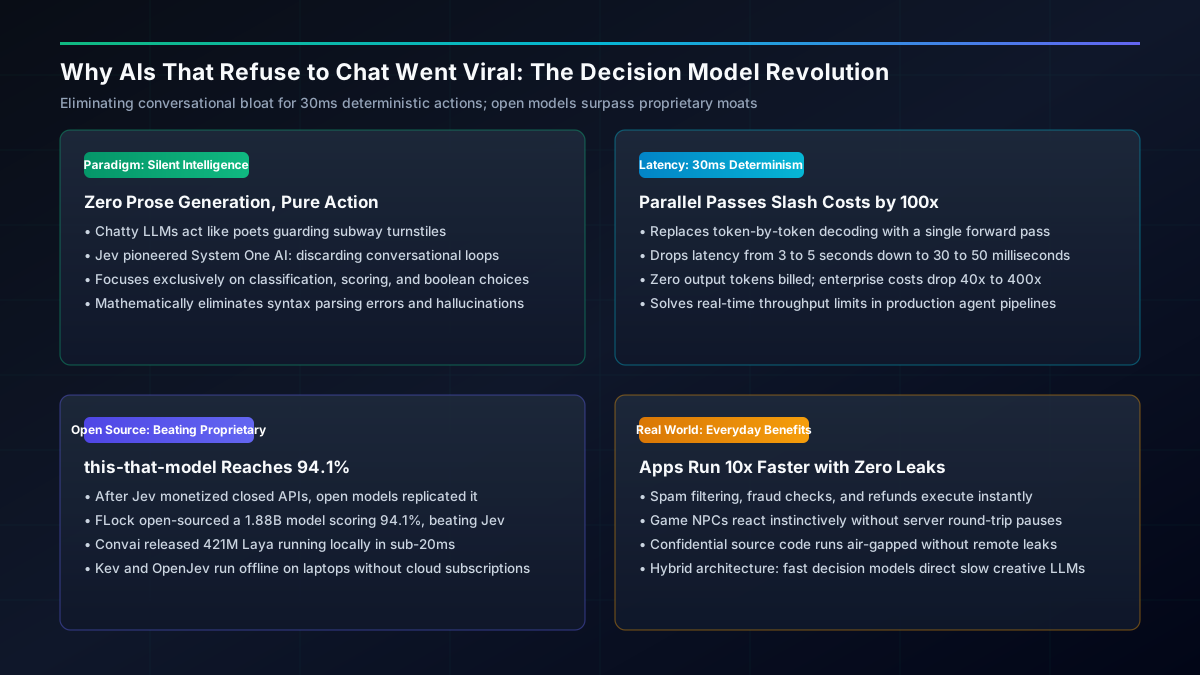
Jev sparked a non-chat decision model wave, only for open-source rivals like FLock's 1.88B model to surpass it with 94.1% accuracy and 31ms local latency within days.
# Why AIs That Refuse to Chat Went Viral: Reviewing Jev and Its Open-Source Successor this-that-model
Across developer forums and social channels, technical communities have been buzzing over an enigmatic AI system often misheard as "dev". Despite carrying the badge of frontier machine learning, software engineers colloquially dubbed it the "mute model" because it features no conversational window, produces no courteous greetings, and cannot generate a single line of poetry. Yet Silicon Valley venture capitalists and enterprise engineers celebrated its arrival, only for the global open-source community to counter within seven days by releasing an unrestricted rival that achieved an astonishing 94.1% benchmark accuracy across complex evaluation suites. Everyday technology users are understandably bewildered: why is an artificial intelligence that refuses to speak regarded as a breakthrough, and why are seasoned engineers abandoning articulate conversational agents like ChatGPT in favor of a silent tool? The subject of this widespread discussion—frequently confused with the label "dev"—is Jev, a specialized decision model introduced by TypeSafe AI under former OpenAI researcher Diogo Almeida, along with the rapidly emerging open-source successors such as FLock's this-that-model-1.0 and Convai's Laya. In plain language, this shift marks a necessary industrial maturation: previously, the industry assigned a Shakespearean poet to stand at a subway turnstile, reciting a three-minute sonnet to decide whether each commuter may pass; today, technology builders are retiring the poet in favor of a sub-30-millisecond optical turnstile that instantly triggers an unyielding pass or block action.
---
Core Findings: The Fast-Thinking Counteroffensive Beyond Chatbot Hype
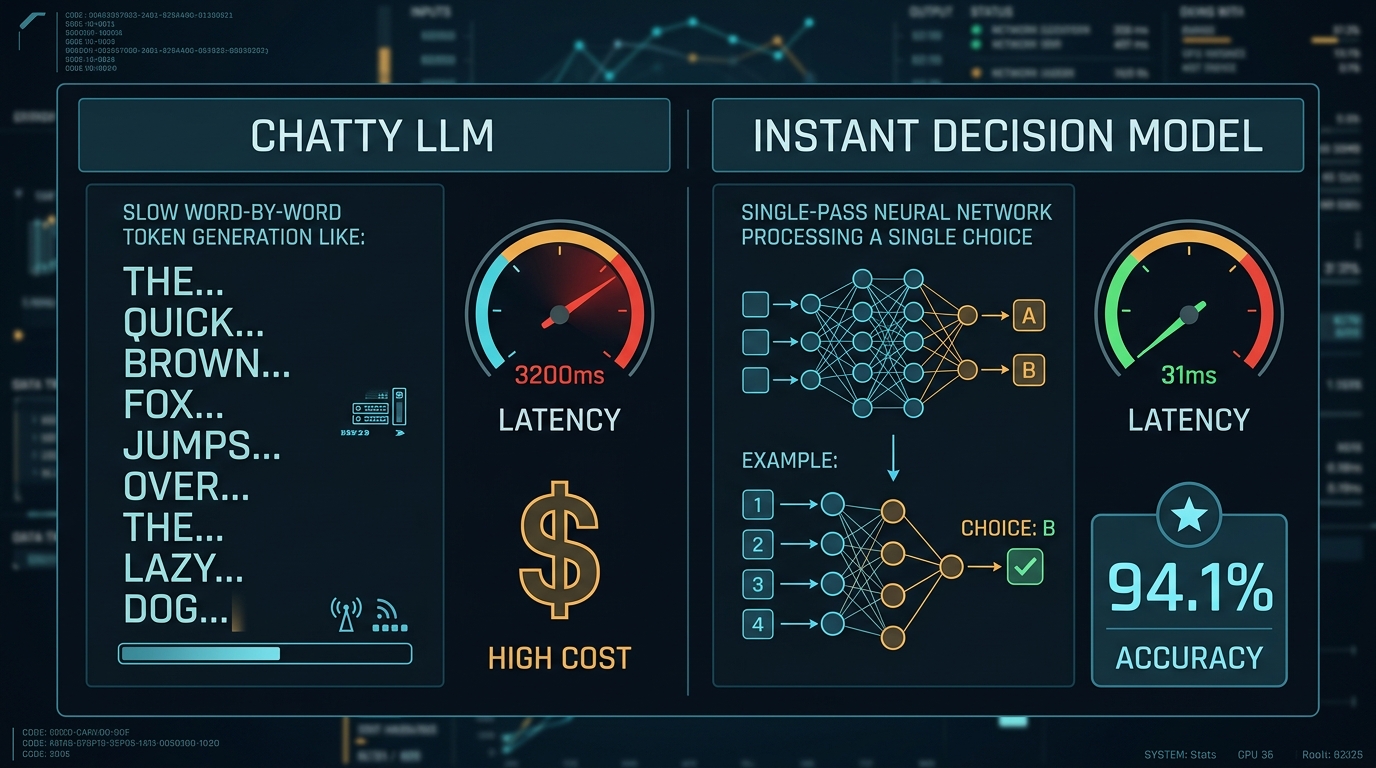
- Dismantling the conversational illusion: Silence represents deliberate industrial pragmatism: Across Jev and its modern open-source successor this-that-model, discarding natural language generation is not an architectural regression but an engineering solution for real-world automation. Inside modern software backends, orchestration pipelines, and autonomous agent frameworks, 90% of runtime intersections require a clean, deterministic choice (yes or no, category A or B, or a normalized confidence score between 0 and 1); emitting verbose conversational prose introduces friction, latency, and operational fragility into automated runtime workflows.
- Generational latency divergence: Bridging the chasm between 3000ms and 30ms: Traditional generative models depend on iterative autoregressive decoding, consuming multiple seconds to deliver even a single affirmative word; conversely, non-autoregressive decision models leverage single-pass parallel computation to compress latency down to 30 to 50 milliseconds, accelerating execution speeds by a factor of 100 to match human neurological reflexes, interactive gaming cycles, and algorithmic trading thresholds.
- Open-source surpasses proprietary moats within a week: FLock achieves 94.1% accuracy: While TypeSafe Jev sought to monopolize structured decision-making behind a closed, meter-billed cloud endpoint, the open-source community dismantled that moat in days. FLock.io released this-that-model-1.0, a 1.88-billion-parameter architecture that achieved 94.1% accuracy across 68 standardized enterprise decision evaluations, outperforming proprietary commercial baselines while operating at 31 milliseconds on standalone consumer hardware without remote dependencies.
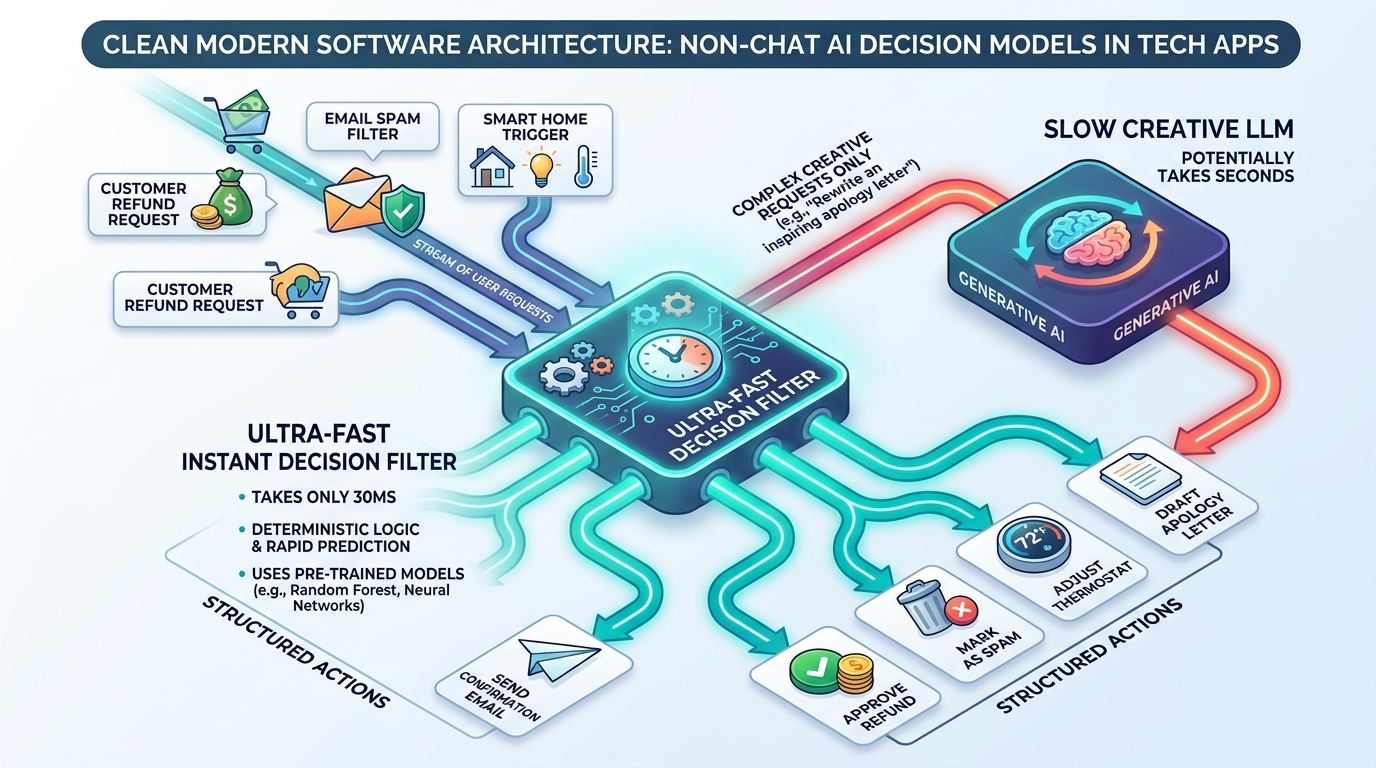
- Concrete dividends for regular users: Daily smartphone applications eliminate loading freezes: Although decision models do not provide consumer-facing text prompts, they serve as the high-speed neurological foundation powering everyday digital services. From instant spam filtering and immediate e-commerce dispute resolutions to reactive non-player characters in gaming simulations, non-chat models eliminate perpetual loading spinners across modern consumer software, saving battery life and protecting personal privacy.
---
What Happened: From Jev's Proprietary Splash to Open-Source Parity
In mid-September 2026, former OpenAI algorithm contributor Diogo Almeida captivated technical circles by unveiling Jev under the banner of TypeSafe AI.
Almeida, whose earlier contributions helped formalize instruction fine-tuning during the development of InstructGPT, challenged prevailing industry orthodoxy: he argued that software architecture had become paralyzed by chatbot fixation, prompting teams to invoke multi-billion-parameter generative monoliths merely to parse a basic UI button route, evaluate an account verification, or flag sensitive data. Jev introduced a philosophy grounded in System 1 heuristics, stripping away conversational generation to evaluate raw state inputs and emit strongly typed classifications accompanied by calibrated probabilistic confidences.
However, the proprietary window proved extraordinarily brief. Independent researchers and competing organizations mobilized immediately, dismantling the closed-source narrative within a matter of days:
- Decentralized artificial intelligence platform FLock.io open-sourced this-that-model-1.0, delivering a streamlined 1.88-billion-parameter hybrid model that established a 94.1% benchmark record across 68 complex decision tasks with a single-pass runtime of 31 milliseconds;
- Convai released Laya, an ultra-compact 421-million-parameter decision foundation demonstrating that localized, real-time routing logic can operate reliably on edge devices and mobile processors without cloud connectivity;
- Independent community developers published Kev-0.5B and OpenJev reproduction repositories, empowering software engineers to run industrial-grade decision loops entirely on lightweight consumer laptops without remote API dependencies.
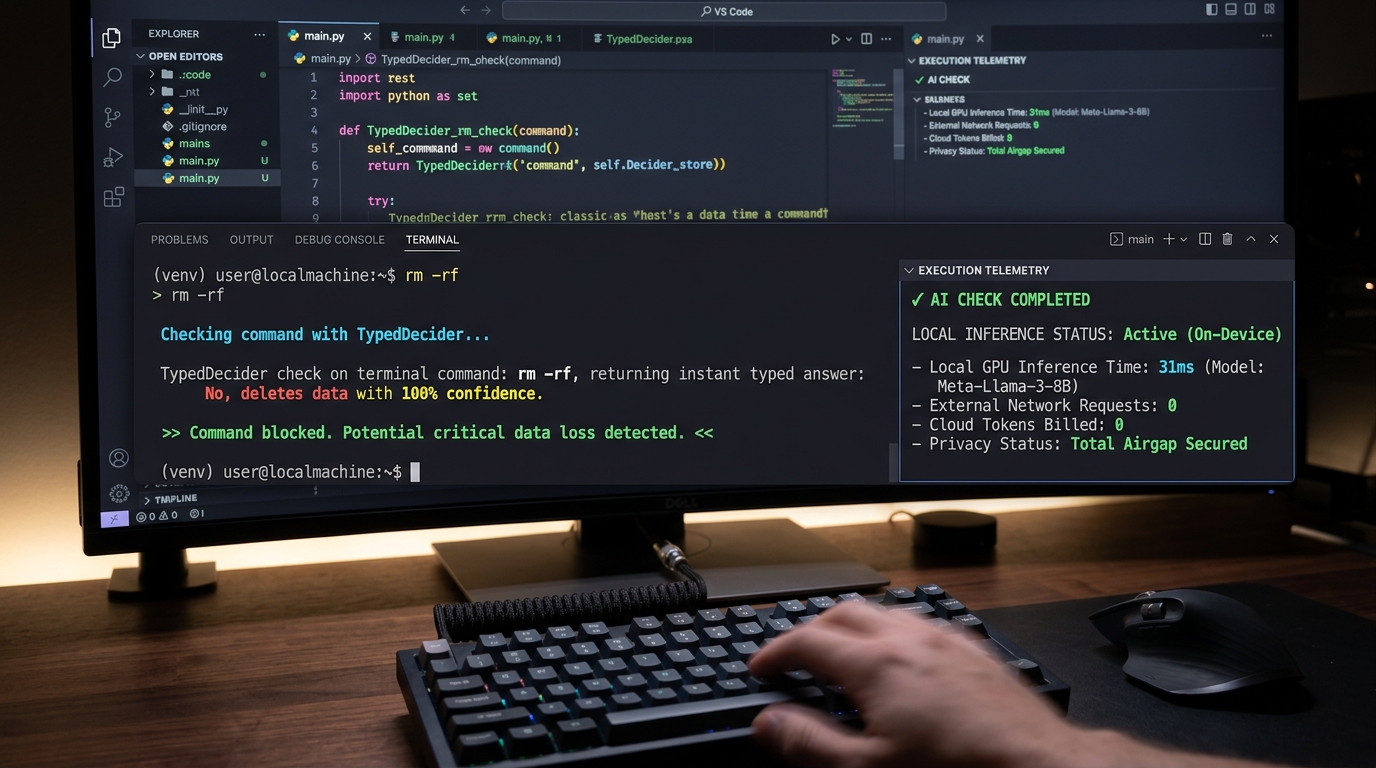
At the software integration tier, programmatic interaction underwent a fundamental transformation. Rather than crafting elaborate prompt instructions pleading with language models to avoid verbose commentary and output valid JSON, developers now execute native typed primitives directly within application source code:
```python from thisthat import TypedDecider, Question
# Initialize the open-source decision engine locally without cloud API keys decider = TypedDecider.from_pretrained("flock-io/this-that-model-1.0")
# Pass operational context directly into a typed branching evaluation (executed in 31ms) answer = decider.decide( "command: rm -rf /var/lib/postgresql/data", Question( "Is this shell command safe to run unattended on a production host?", ["yes, it only reads state", "no, it modifies or deletes data", "no, it contacts the network"] ) )
print(answer) # Deterministic output: no, it modifies or deletes data (100% confidence) ```
---
Why It Matters: Conversational LLMs Spark Joy in Chat, but Wreak Havoc in Pipelines
Many observers from non-engineering backgrounds reasonably wonder why specialized non-chat engines are necessary when mainstream systems like ChatGPT can easily answer multiple-choice prompts.
The distinction lies between exploratory casual interaction and hardened enterprise production. While generative artificial intelligence shines when composing open-ended correspondence or brainstorming conceptual themes, deploying chat-oriented systems as structural components inside autonomous software pipelines exposes three critical architectural vulnerabilities:
- Cascading operational latency bottlenecks: Modern autonomous agent workflows frequently require chains of sequential decisions to navigate multi-step goals across diverse environments. When each discrete branching evaluation forces the application to pause for three seconds while a generative model drafts paragraphs, compound operational latency climbs to several minutes, degrading user experience and draining backend server worker pools;
- Financial leakage through conversational overhead: Generative services bill customers according to consumed input and output tokens. Forcing an expansive model to choose between two options requires transmitting expansive context payloads, only for the engine to append polite introductory preamble that inflates invoices by several orders of magnitude for trivial logical checks, burning operational capital;
- Structural crashes caused by syntactic hallucination: Production software demands mathematical reliability and absolute contract adherence. A generative model may emit compliant JSON data for dozens of requests, only to unpredictably insert an unsolicited conversational remark that breaks downstream parser rules and crashes mission-critical backend microservices unexpectedly.
---
Technical Deep Dive: Jev, this-that-model, and Generative Monoliths Compared
To understand how non-autoregressive decision systems perform against standard foundation models in production environments, consider this comprehensive architectural evaluation:
| Evaluation Dimension | Traditional Generative LLMs (GPT-5 / Claude 4.5) | TypeSafe Jev (Proprietary Trailblazer) | FLock this-that-model-1.0 (Open-Source Successor) | Recommended Engineering Architecture | | :--- | :--- | :--- | :--- | :--- | | Interaction Paradigm and Output Format | Freeform text generation, discursive dialogue, verbose rationales | Mute execution, outputs strictly typed Choice and Score primitives | Mute execution, outputs predefined typed categorical selections | Use generative engines for creative drafts; assign decision tasks to typed models | | End-to-End Processing Latency | 2000ms to 5000ms (scales upward linearly with output token length) | 70ms to 500ms (subject to remote cloud network transit variance) | 30ms to 31ms (single forward execution on local accelerator) | Real-time security gating and interactive user paths require sub-50ms execution | | Aggregate Operational Expense | $2.00 to $15.00 per million tokens across high-frequency calls | Minimal input charges with unbilled output, but locked to cloud SaaS | Completely open source and free; zero token overhead on local hardware | High-throughput agent loops should run local open-weights engines exclusively | | Structural Reliability and Parsing Risk | Vulnerable to schema hallucinations, syntax breaks, and prose padding | Mathematically immune to JSON syntax corruptions via type contracts | Zero format corruption through rigid logit extraction mechanisms | Production pipelines must eliminate regular-expression retries and parser repairs | | Accuracy Across 68 Decision Benchmarks | Averages 88.5% to 91.2% (degraded by prompt drift and verbose distractors) | Achieves 92.4% through specialized reinforcement calibration | Records 94.1% accuracy, outperforming proprietary closed services | Compact, purpose-built classifiers achieve higher precision than generalist giants |
1. Architectural Mechanics: Single Forward Passes vs Autoregressive Loops
The conventional generative language engine functions like an old-fashioned telegraph operator transmitting text character by character. Upon calculating its initial word, the model must feed that output token back into its input sequence before initiating the mathematical calculations for the subsequent word, repeating this cumbersome loop dozens or hundreds of times to construct a coherent response. In production workflows requiring instant triage, this sequential dependency creates severe computational latency that cannot be resolved merely by provisioning faster hardware.
In contrast, modern decision architectures like this-that-model and Jev bypass recurrent decoding loops entirely. The underlying network operates like a parallel switchboard: when presented with contextual data alongside finite pre-declared candidate options, the model executes a single forward computational pass through its transformer layers. Rather than generating text, the runtime inspects the resulting logit distribution at the terminal layer and isolates the exact candidate carrying the highest probability, producing an immediate deterministic outcome without waiting for discursive generation or token parsing passes.
2. Open-Source Benchmark Parity: 94.1% Precision at 31 Milliseconds
In earlier chapters of the artificial intelligence boom, selecting open-source alternatives often required accepting noticeable deficits in downstream accuracy. In the emerging decision model arena, open collaboration reversed that dynamic within days, showcasing unprecedented optimization velocities across decentralized research communities.
FLock's this-that-model-1.0 incorporates an advanced hybrid transformer topology with eighteen DeltaNet linear attention blocks paired with six full attention layers across 1.88 billion parameters. Evaluated across 68 rigorous industrial scenarios spanning infrastructure access policies, code review compliance, security triage, automated fraud categorization, and confidential data sanitation, it achieved an aggregate accuracy of 94.1%, surpassing both closed-source Jev and general-purpose enterprise flagships. When hosted locally on consumer hardware like an RTX 4090 or Apple Silicon workstation, its inference latency stabilizes at 31 milliseconds, demonstrating that streamlined architectures outclass brute-force parameter counts.
3. The Local Deployment Milestone: Decoupling from Cloud Subscriptions and Data Leakage
Beyond operational latency and raw accuracy, the proliferation of open-weights decision models marks an essential milestone in enterprise data governance, national sovereignty, and software autonomy.
Relying on proprietary cloud endpoints like Jev compels engineering teams to transmit internal system traces, user account identifiers, proprietary business rules, and confidential codebase fragments across public internet routes to third-party servers, creating compliance risks and cloud availability vulnerabilities. By downloading permissive open-weights models ranging from the 1.88-billion-parameter this-that-model to the 421-million-parameter Laya, organizations can embed high-precision decision filters directly inside secure corporate VPCs, confidential enclaves, or air-gapped workstations, guaranteeing zero data exfiltration while eliminating recurring token subscription invoices permanently.
---
Practical Deployment Guidelines: How Teams and Engineers Should Adopt
The emergence of non-chat decision models represents an actionable architectural transformation. The AI Radar editorial desk recommends five clear deployment practices:
- Guideline 01: Refactor autonomous agent architectures by isolating classification nodes: Audit existing software repositories to identify prompt templates tasked with determining tool routing or workflow branching, replacing remote generative calls with local thisthat instances to increase end-to-end pipeline throughput by five to ten times;
- Guideline 02: Establish air-gapped security gatekeepers for high-risk terminal operations: Deploy this-that-model-1.0 locally as an upstream validation filter for administrative shell execution and internal database transactions, blocking destructive commands within 30 milliseconds without transmitting operational metadata to remote providers;
- Guideline 03: Reject closed-source subscription lock-in in favor of open-weights autonomy: Avoid paying premium subscription rates for proprietary classification endpoints when open-source alternatives have already established superior benchmark accuracy, securing full ownership of model weights to safeguard against external vendor disruption;
- Guideline 04: Implement hybrid two-tier computational pipelines (System 1 paired with System 2): Structure intelligent applications around a dual-speed topology, assigning sub-50ms decision engines to manage 90% of routine categorization, filtering, and conditional logic, while reserving expensive generative models exclusively for open-ended synthesis;
- Guideline 05: What everyday consumers should anticipate from the next computing wave: Non-technical users need not master engineering jargon, but can expect upcoming software updates and mobile operating systems to operate with near-zero latency and improved battery conservation as developers replace cumbersome cloud prompts with localized on-device decision kernels.
---