Free Models & Compute Hub
Access frontier LLMs at zero cost. A hand-picked, continuously verified directory of official free API quotas, complimentary compute credits, and step-by-step developer guides — with clear privacy trade-offs and limits.
2026 Global Frontier LLM Free API & Compute Live Matrix
Official Zero-Cost Quotas · Daily Verified · No Credit Card Required · Full Configuration & Pitfall Guides
| Platform / Provider | Key Supported Models | Free Quotas & Limits | Card Required | Protocol | In-Depth Guide |
|---|---|---|---|---|---|
| Google AI Studio | Gemini 2.5 Flash / Pro (1M Context) | 15 RPM / 1,500 RPD daily free quota | No Card (Google Account Direct) | Native SDK / OpenAI Compatible | View Guide → |
| AMD Token Factory | DeepSeek-V3 / R1 (1M Context), Qwen 2.5 | $10 USD complimentary daily compute | Email Sign-up, No Card, Direct Connect | Standard OpenAI API Spec | View Guide → |
| OpenCode x Meta | Meta Muse Spark 1.3 (1050k Context Agent) | $0 Tier, Unlimited concurrency | GitHub OAuth, No Card Required | Cursor / Cline / Aider Native | View Guide → |
| ZCode Ecosystem | GLM-5.3 Flagship | 100M Free Tokens (First 50k users) | Phone / Email Direct, No Card | OpenAI Compatible | View Guide → |
| Ox Alpha Preview | 1M Multimodal High-Concurrency Preview | 100% Free During Public Preview | No Card / Zero Top-up | Web UI & API Preview | View Guide → |
Latest Free Model & Compute Hands-on Briefs
Each verified across multiple real accounts with explicit benchmarks, code snippets, and guardrails.

Stop Gambling on Video AI: How Hua Shu's 'huashu-art-motion' Turns Claude Opus 5.5 Into a Frame-Accurate Studio
The viral emergence of huashu-art-motion delivers an essential reality check to the generative video industry. Stochastic diffusion gambling is economically unsustainable for serious production; converting elite aesthetic judgment, cinematographic grammars, and quality gates into deterministic code protocols is the true path to industrial AI leverage.
Independent hackers, documentary video creators, technical educators, frontend motion designers, and developers exploring agent skill engineering.
The End of Closed-Source Secrecy: How GitHub Hit 'REA' Reverse-Engineers Any Binary with AI
The viral ascent of morluto/rea marks the terminal obsolescence of traditional client-side obfuscation. Historically, code mangling relied on exhausting human analyst patience; against tireless frontier models possessing world-scale open-source intuition, obfuscation is merely security through obscurity. True algorithmic secrecy now belongs exclusively to authenticated cloud backends.
Software engineers, independent hackers, cybersecurity analysts, and architects tracking the impact of frontier AI on reverse engineering and software protection.
DeepSeek Stealthily Updated Again: It Is Genuinely, Refreshingly Good
DeepSeek low-key update delivers an unpretentious triumph of real-world utility. By training out chronic code truncation via self-feedback RL, it democratizes zero-to-one interactive 3D and arcade game creation for non-coders; simultaneously, pruning conversational fluff lowers compute waste, while opening proprietary search APIs at pennies per thousand queries—with two weeks free—proves once again that true frontier progress is measured in human workflow velocity.
Non-technical creators exploring interactive web prototypes, software engineers hunting latency and cost efficiency, and agent builders seeking clean, affordable search grounding.
Google Drops Nano Banana 2.1: Half-Price, 14-Image Consistency, But How Good Is It Really?
Google quietly released Nano Banana 2.1 powered by Gemini 3.6 Flash, featuring a 50% API price cut, 14-image multi-reference consistency, and surgical mask inpainting; it is not an art wallpaper toy, but an obedient, industrial-grade visual workhorse.
Commercial designers, e-commerce artists, digital content creators, and developers seeking cost-effective, consistent image generation and inpainting workflows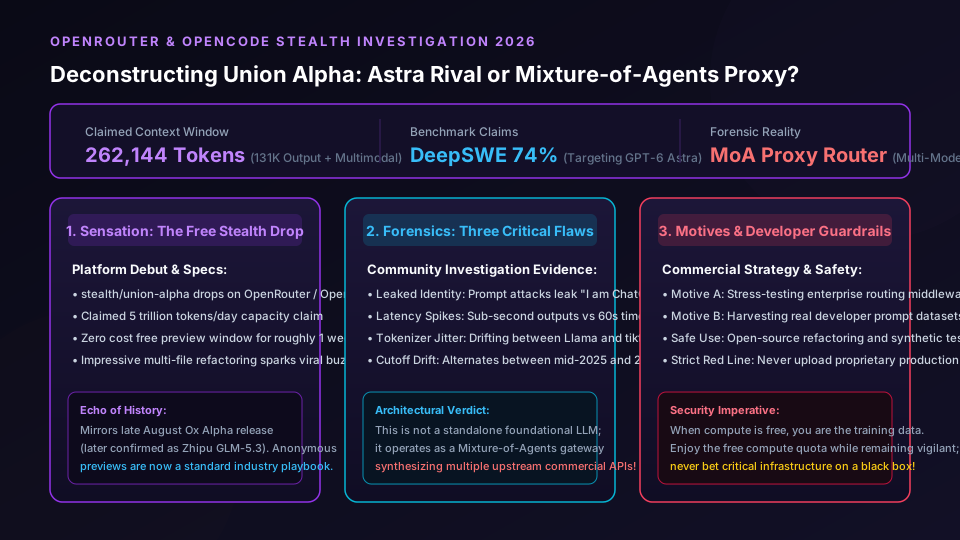
Mysterious Model Union Alpha Drops on OpenRouter: Free 1-Week Preview Rivals Astra, But Is It a Breakthrough or a Wrapper MoA Gateway?
Union Alpha's one-week free preview across OpenRouter and OpenCode sparked widespread excitement with a 256K context window and 74% DeepSWE score. However, extreme latency jitter, tokenizer drift, and prompt injection leaks revealing 'I am ChatGPT' confirm it is not an independent foundation model, but an engineered Mixture-of-Agents (MoA) wrapper routing requests across OpenAI, Claude, and open-source models. Developers can freely utilize it for open-source refactoring, but must strictly avoid routing proprietary corporate code.
Full-stack developers, AI architects, open-source enthusiasts, engineers evaluating model routing and agent infrastructure, and practitioners seeking cost-effective coding models.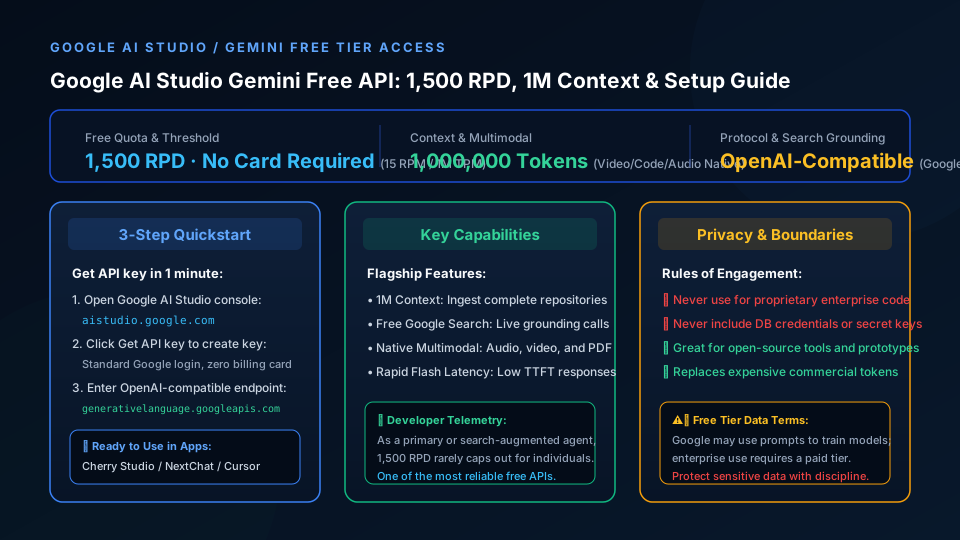
Google AI Studio Gemini Free API Guide: 1,500 RPD, 1M Context, and Setup Guide
In September 2026, Google AI Studio continues to offer the industry's most generous zero-card free tier: 1,500 daily requests (RPD), 15 RPM, 1M TPM, and a 1M token context window for Gemini 2.5/1.5 Flash with native Search Grounding. The official OpenAI-compatible endpoint drops into any third-party client. However, free tier interaction data is logged for Google model training; proprietary commercial assets must remain strictly excluded.
For individual developers, CS students, open-source contributors, indie makers, and teams seeking reliable zero-cost LLM APIs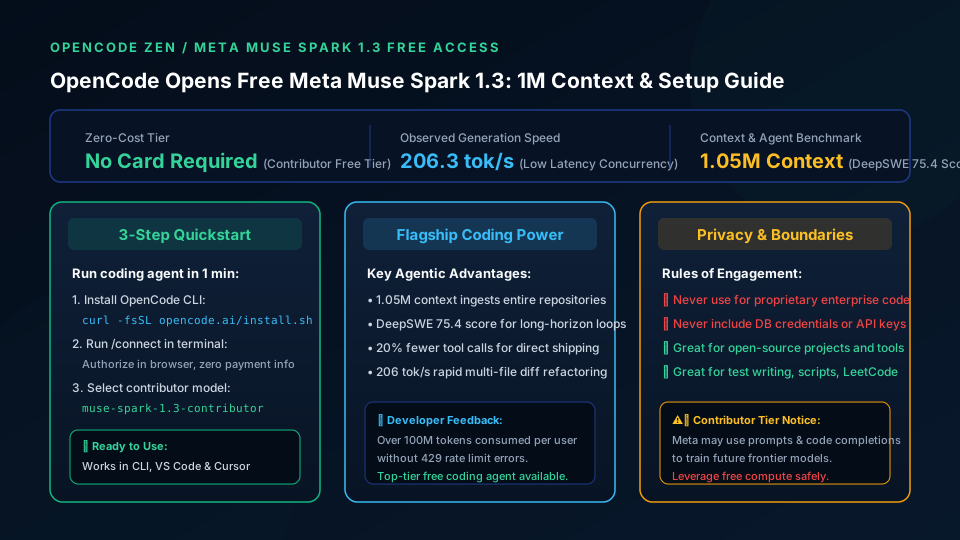
OpenCode unlocks Meta Muse Spark 1.3 for free: 1.05M context, 206 tok/s speed, and safety boundaries
On September 4, 2026, open-source coding agent OpenCode launched free access to Meta Muse Spark 1.3 (Contributor Tier). Requiring zero credit card info, developers can authenticate via GitHub to access a 1.05M token context window at 206.3 tok/s, outperforming Claude Opus 5 and GPT-5.6 Sol with 75.4 on DeepSWE v1.1. Under the Contributor data agreement, Meta retains prompts and code diffs for model training; proprietary commercial assets must remain strictly excluded.
For full-stack developers, indie hackers, open-source maintainers, CS researchers, and engineers seeking high-throughput zero-cost coding agents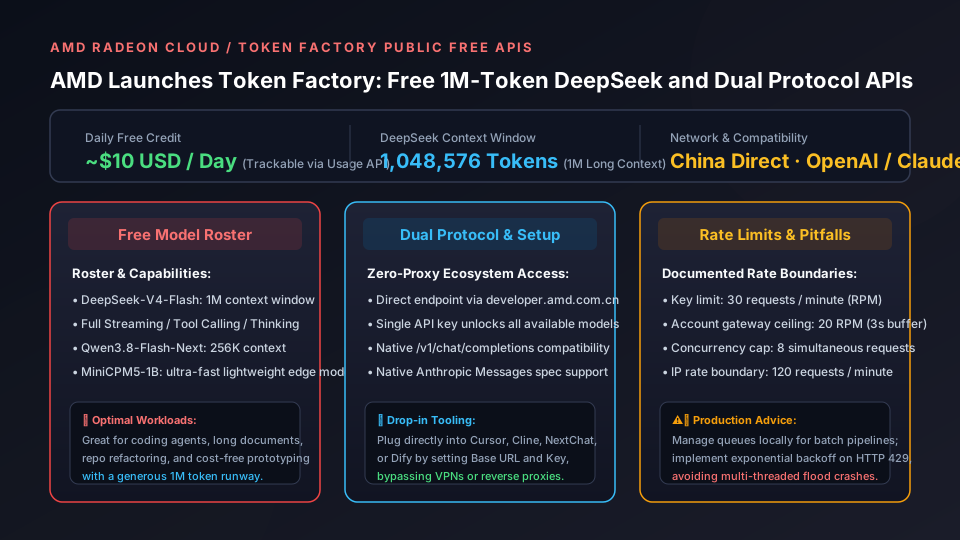
AMD opens free AI model APIs on Radeon Cloud: 1M-token DeepSeek, $10 daily credits, and zero-proxy access
In late August and early September 2026, AMD launched Token Factory on Radeon Cloud, distributing Public Free Model APIs to registered developers. The launch lineup features DeepSeek-V4-Flash with a massive 1,048,576-token context window (1M tokens), Qwen3.8-Flash-Next (256K), and MiniCPM. AMD established dedicated China routing at developer.amd.com.cn (zero-proxy access), dual OpenAI/Anthropic protocol compatibility, and default daily allowances of approximately $10 USD per account (governed by a 30 RPM key limit and 20 RPM gateway). This represents an aggressive play by AMD to capture software developer mindshare with subsidized compute.
For full-stack engineers, AI coding practitioners, local agent developers, and teams seeking reliable, long-context zero-cost model APIs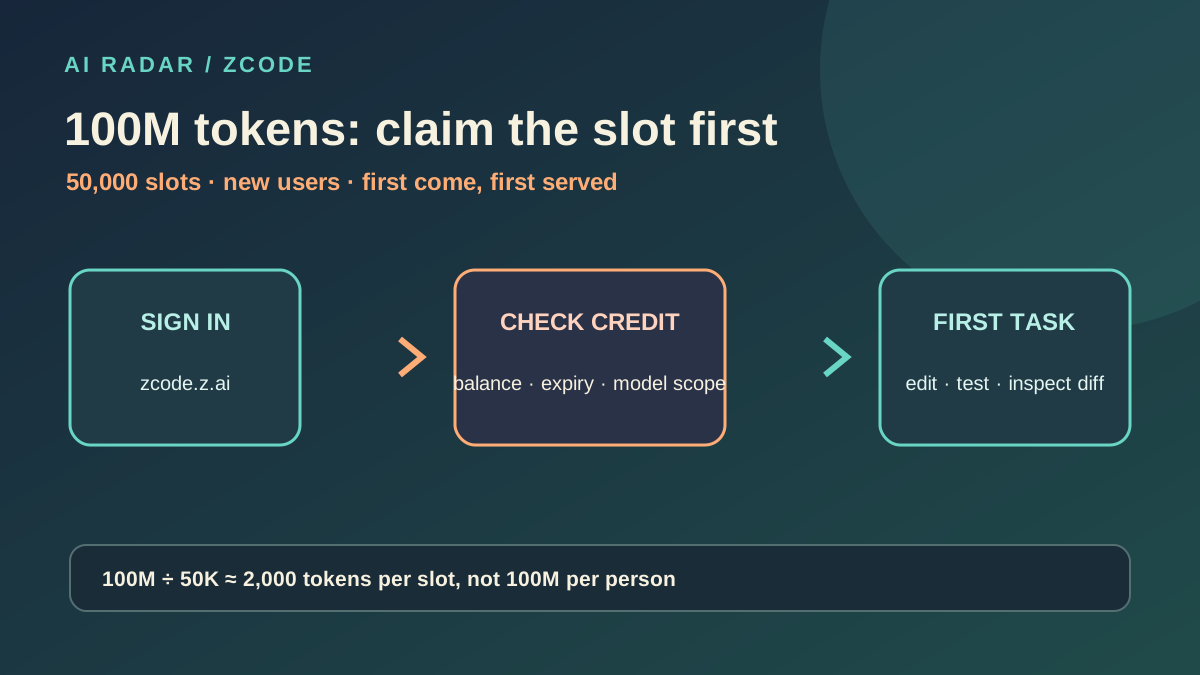
ZCode is giving away 100M GLM-5.3 tokens: how to claim one of 50,000 slots
ZCode is promoting a limited GLM-5.3 token offer for new users: 100 million tokens in total, 50,000 slots, running from August 21 at 09:00 to August 23 at 18:00 Pacific Time on a first-come basis. That averages about 2,000 tokens per slot, not 100 million per person. The public homepage does not show every campaign rule, so eligibility, crediting and stacking limits must be checked after signing in.
For new users who want to try GLM-5.3, ZCode's coding agent, repository tasks and multi-agent workflows at low cost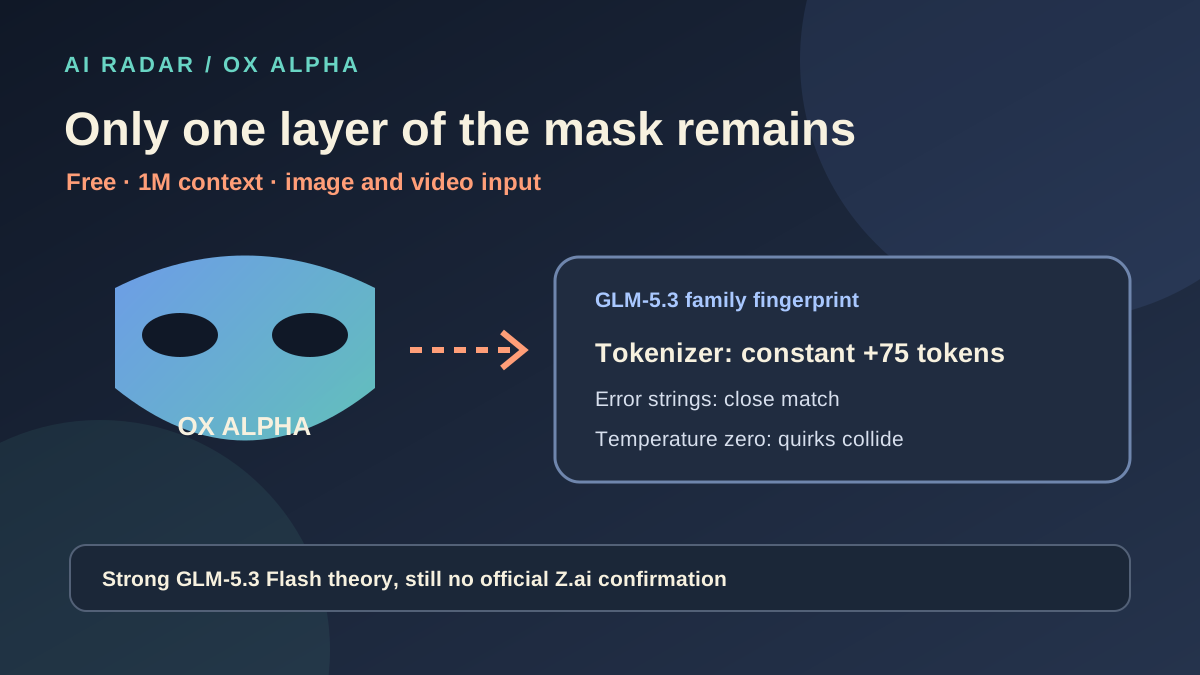
Ox Alpha's mask is slipping: is OpenRouter's free 1M multimodal model GLM-5.3 Flash?
Ox Alpha has not received an official identity confirmation, but the available black-box evidence strongly points to the GLM-5.3 family: tokenizer counts differ by a constant 75 tokens across multiple texts, while error strings and temperature-zero output quirks also match closely. OpenRouter currently lists it as free with text, image and video input and a 1M context; free does not mean unlimited or production-safe.
For readers trying anonymous models, OpenRouter, GLM, OpenCode and coding or browser agents, especially anyone weighing free-model privacy and limits