OpenAI Drops GPT-6.1 Terra: The $1 Computer-Use Workhorse Slashing Developer Compute Bills
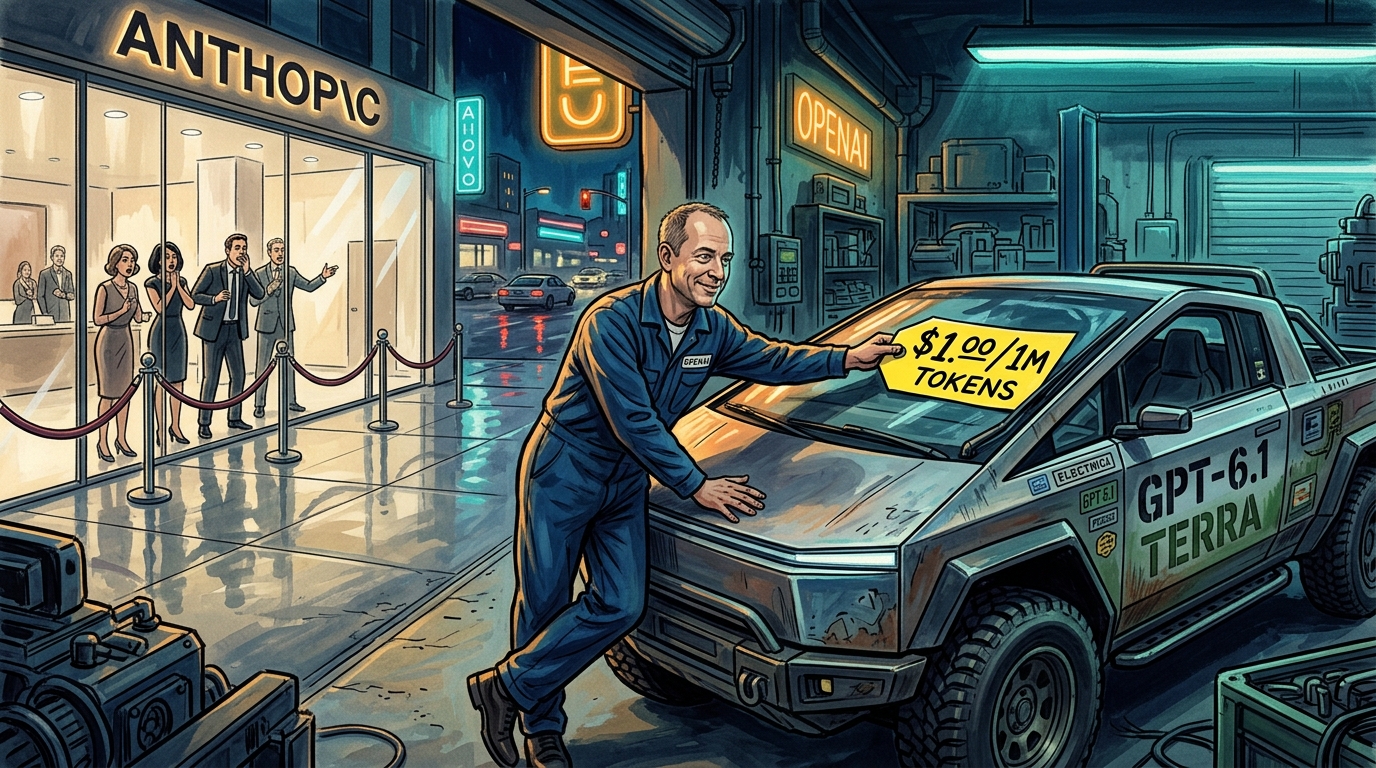
The debut of GPT-6.1 Terra signals a pragmatic shift in OpenAI's competitive strategy from speculative parameter races to cutthroat economic efficiency. By locking high-frequency computer-use and visual reasoning at a rock-bottom dollar-per-million price point, it democratizes sophisticated UI automation previously restricted by enterprise budgets. In an era demanding profitability, rugged, affordable utility remains the ultimate market weapon.
If you write code daily, maintain automated browser pipelines, or have multiple autonomous agents running round the clock in the background, you have almost certainly suffered through that painful reckoning: opening your cloud provider dashboard at the end of the month, staring at eye-watering token charges, and quietly venting that hiring digital silicon assistance has somehow become more expensive than employing a junior engineer in an entry-level studio.
Late yesterday evening, OpenAI quietly dropped a significant new model across the OpenAI API, ChatGPT Work, Codex, and GitHub Copilot without ceremony: GPT-6.1 Terra.
There was no glossy keynote presentation and none of Sam Altman's grand philosophical declarations about imminent artificial general intelligence saving civilization. Yet for practical developers living inside terminal shells and production repositories, this quiet release is infinitely more useful than the overhyped flagship models that dominated previous tech headlines.
To summarize it plainly: OpenAI stopped chasing artistic poetry and built a brutally discounted, rugged industrial tractor designed exclusively for heavy daily labor.
The Keynote Hype Cycle Is Over: OpenAI Delivers a Realistic Daily Workhorse Instead of Empty Promises
Over the past three quarters, developers have grown thoroughly exhausted by the predictable marketing formulas favored by leading AI laboratories.
Labs either parade their supreme flagship models—such as GPT-6 Astra or Claude Opus—across benchmark charts with blinding evaluation scores, accompanied by pricing schedules packed with enough zeroes to induce financial panic; or they ship ultralight mini-models like Luna or Haiku, which are genuinely inexpensive but disintegrate into syntax errors and hallucination loops the moment an actual engineering task requires multi-step context.
What builders have consistently demanded is a dependable mid-tier engine: sharp enough to follow directions, fast enough to interpret user interfaces without latency, capable of piloting browsers and terminals reliably, and crucially, priced affordably enough that teams can run it unmonitored twenty-four hours a day without fear of financial ruin.
The newly deployed GPT-6.1 Terra was engineered specifically to conquer that long-neglected operational niche.
One Dollar Versus Fifteen: Slashing Desktop Automation Costs to Attack Claude Across Its Flank
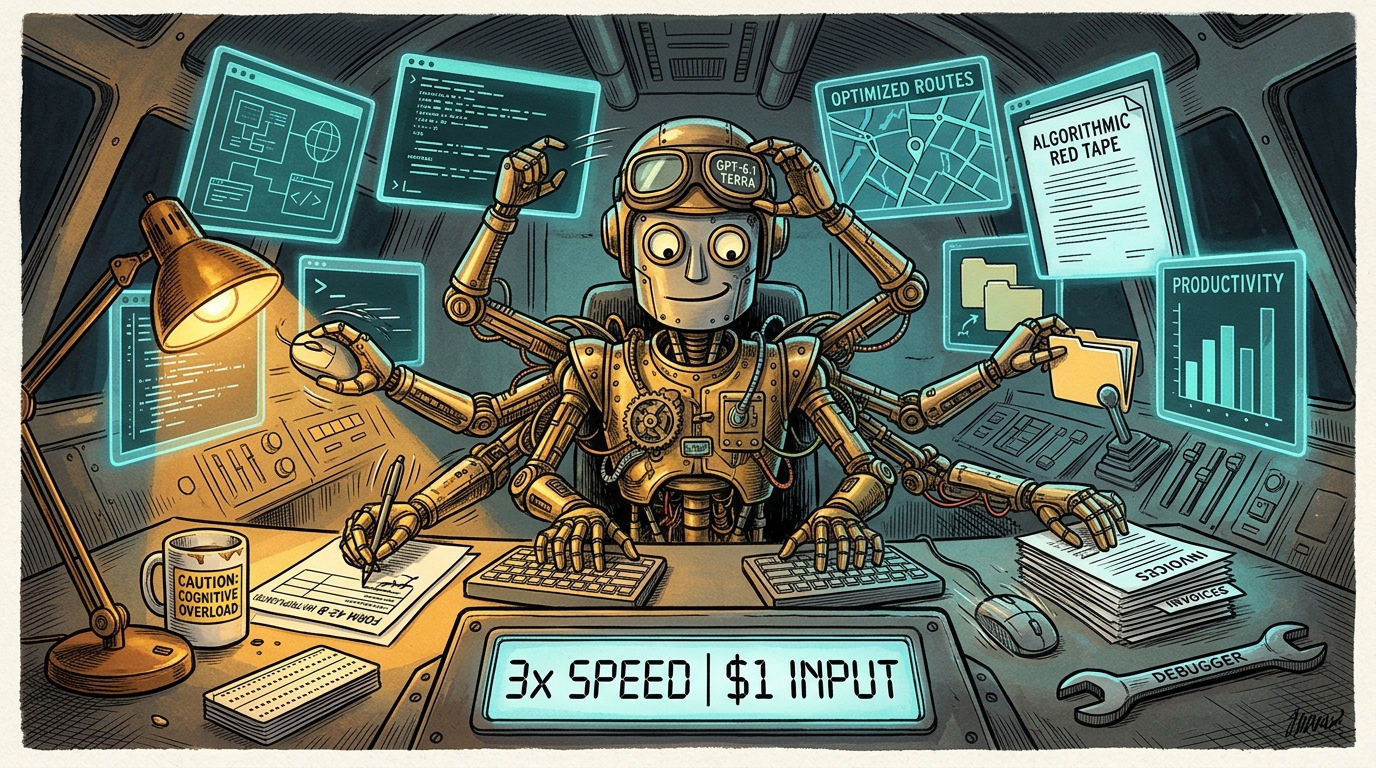
To grasp the commercial impact of this release, one can ignore convoluted benchmark radars and focus strictly on two practical metrics:
1. A Budget-Friendly Invoice of One Dollar Input and Five Dollars Output: At the standard API tier, OpenAI locked Terra's pricing at \$1.00 per million input tokens and \$5.00 per million output tokens. By comparison, competing frontier models capable of autonomous computer-use workflows regularly cost five to ten times as much. Under an identical infrastructure budget, a quality-assurance test suite that previously could only run for half an afternoon can now execute continuously across an entire work week; 2. Aggressively Optimized for Computer Use and Visual UI Execution: Unlike earlier iterations, OpenAI avoided dumping compute parameters into speculative creative writing, funneling nearly all model distillation efforts into visual reasoning and user interface navigation. Whether parsing dense engineering schematics, transferring tabular figures across accounting software, solving dynamic web verification challenges, or clicking through complex desktop applications, its operational latency runs roughly three times faster than flagship Astra while matching its accuracy score.
This tactical adjustment represents a direct shot across Anthropic's bow. Over recent quarters, Claude established a virtual monopoly over desktop automation through its pioneering Computer Use feature, using that exclusivity to maintain premium pricing tiers. With the arrival of Terra, OpenAI's strategic counter is transparent: while competitors position themselves as high-end bespoke fashion houses, OpenAI is mass-manufacturing durable denim overalls for ten dollars flat.
Triple the Speed, but Never Expect It to Compose Philosophical Poetry
Naturally, there is no such thing as a free technological lunch, and expecting a one-dollar model to achieve universal perfection is unrealistic.
Early telemetry from developers integrating the API reveals strengths and limitations that align directly with its unpretentious designation:
Inference throughput is remarkably swift because the architecture underwent extensive distillation and pruning tailored specifically to user-interface interactions. When an autonomous workflow cycles through capturing screenshots, parsing coordinate buttons, executing clicks, and streaming execution logs, the system eliminates the agonizing pauses historically associated with long reasoning loops.
However, if you task it with drafting an emotionally nuanced essay or formalizing advanced mathematical proofs, its industrial nature becomes immediately apparent: prose is blunt, creative flair is absent, and analytical shortcuts occasionally appear. It was never intended to compete for literary prizes; it was forged purely as a tireless assembly line laborer.
The Developer Balance Sheet: Saving Enough Every Month to Buy Hardware Upgrades

For independent engineers and lean startup teams, the immediate dividend of Terra manifests as tangible capital savings:
1. Autonomous Web Scraping and Robotic Process Automation: Immediate Seventy Percent Savings: If your daily workflows rely on headless browser agents crawling dynamic data feeds, a single visual inspection loop processing hundreds of complex pages previously evaporated substantial capital. Migrating those routines to Terra slashes operational expenses by more than two-thirds, expanding project fault tolerance exponentially; 2. Document Processing Pipelines and Customer Support Routing: Eradicating Compute Bankruptcy: For enterprise pipelines managing invoice validation, contractual triage, and high-volume ticket routing, lightweight models frequently misread numerical strings while flagship models threatened departmental budgets. Terra establishes the elusive economic equilibrium where automated document intelligence finally balances favorably against corporate balance sheets.
Deployment Playbook: What Tasks Belong on Terra and What Demands Flagships
If you plan to incorporate this runtime into your codebases today, implement a straightforward operational division of labor:
1. Tasks to Delegate Without Hesitation: Repetitive, Heavy, and Mechanical Volume: This category includes browser regression testing, bulk form ingestion, unstructured document data extraction, unit test generation, and any agentic loop requiring high-frequency visual inspection tied to deterministic programmatic execution; 2. Work Reserved for Top-Tier Flagships: Global Architectural Synthesis and High-Stakes Logic: Whenever a task demands holistic system architecture design, mission-critical security auditing, esoteric competitive programming challenges, or executive corporate communications, return to flagship frontier models or configure multi-provider fallback routing rather than risking production integrity over modest compute savings.
The trajectory of generative artificial intelligence has finally transitioned from the breathless theological promises of superintelligence toward the sober accounting arithmetic of customer affordability. Making useful tools accessible, and keeping affordable tools exceptionally durable, marks the true threshold where frontier technology lands in the hands of working builders.