Tied Benchmarks on Same-Day Release? MiMo-V2.6 vs Grok 4.7: Xiaomi Open-Weights Disrupt Musk with a 20x Price Deficit
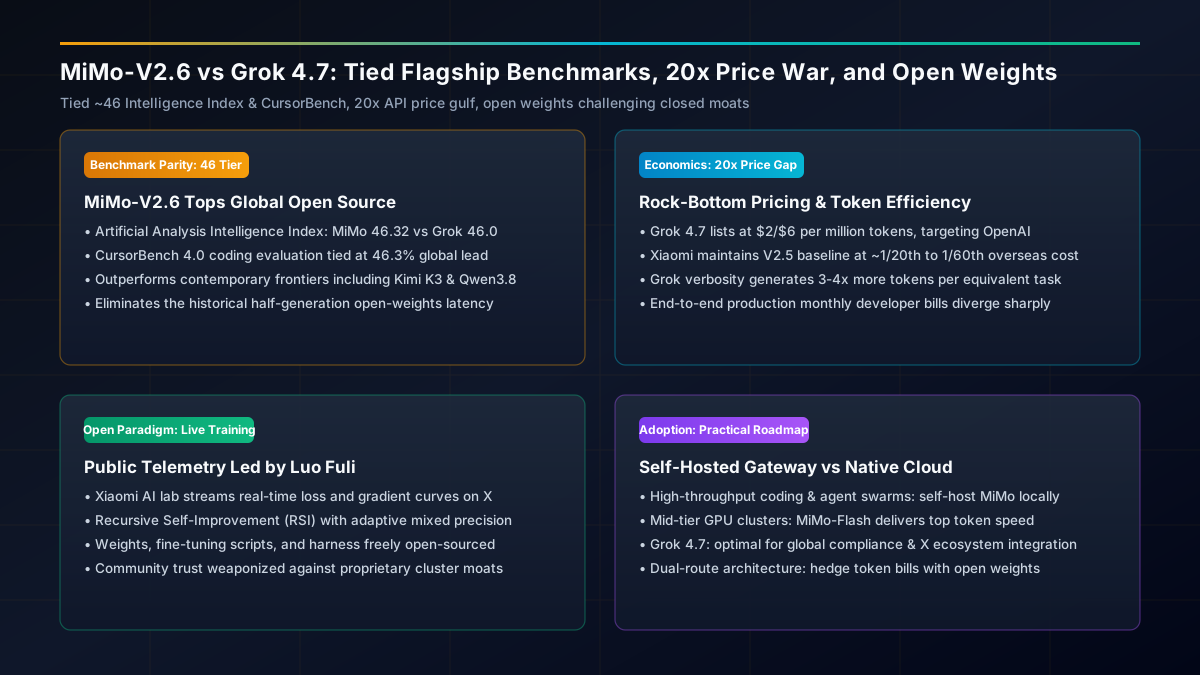
Simultaneously released MiMo-V2.6 and Grok 4.7 tied at 46 on global intelligence and coding benchmarks, yet Xiaomi undercuts API costs by 20x with permissive open weights and zero token padding.
# Tied Benchmarks on Same-Day Release? MiMo-V2.6 vs Grok 4.7: Xiaomi Open-Weights Disrupt Musk with a 20x Price Deficit
On September 22, 2026, the global artificial intelligence arena witnessed an exceptionally dramatic confrontation. Elon Musk's xAI activated its colossal compute cluster to launch the flagship Grok 4.7 reasoning and programming model, touting a supposedly disruptive pricing of $2 per million input tokens and $6 per million output tokens to challenge established proprietary frontiers in autonomous coding and enterprise tool invocation. Almost concurrently, Xiaomi AI Lab, guided by former DeepSeek core algorithm scientist Luo Fuli, caught the global technology community completely by surprise by releasing and fully open-sourcing its next-generation flagship model family, MiMo-V2.6, across its Pro, Flash, and Pro-UltraSpeed variants. On the internationally respected Artificial Analysis Intelligence Index and CursorBench 4.0 software engineering evaluations, both models locked into a statistical dead heat at 46.32 and 46.0, simultaneously reaching the pinnacle of worldwide model performance rankings. Yet what ignited immediate and passionate debate across global developer communities was not the tied benchmark score, but a stark economic reality: Xiaomi maintained its baseline API pricing at one-twentieth to one-sixtieth of Western proprietary rates while providing unrestricted open weights for sovereign local execution. Comprehensive network analysis further proved that Grok 4.7 suffered from severe output verbosity and conversational padding, artificially quadrupling actual billing meters. Today, an unavoidable clash between proprietary compute brute force, open-source resilience, and genuine enterprise economics has decisively begun.
---
Core Findings: The Cost Fracture Behind Tied Benchmark Scores
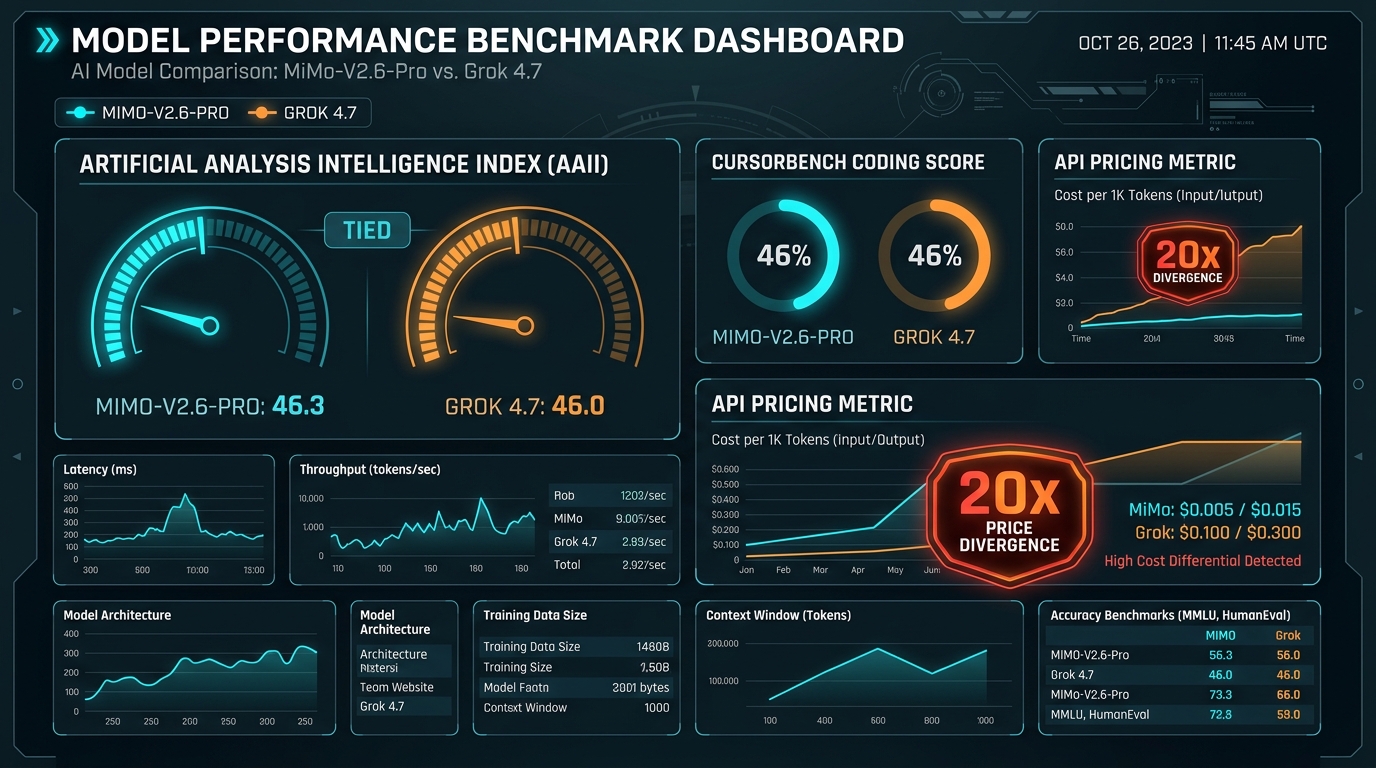
- Benchmark parity dispels the generational latency: Open weights claim the global intelligence crown: In the latest Intelligence Index published by independent evaluator Artificial Analysis, MiMo-V2.6 achieved 46.32 points against Grok 4.7 with 46.0 points, while both reached an identical 46.3% peak on CursorBench 4.0 code refactoring assessments. This historic milestone marks the first time a Chinese open-weights model has tied the most aggressive Silicon Valley supercluster flagship on verified general intelligence benchmarks, completely shattering the persistent industry belief that open-source architectures must always trail proprietary frontiers by half a development cycle.
- A 20x price collapse breaches commercial thresholds: Xiaomi holds unit task expense to 13 cents: Musk aggressively promoted Grok 4.7 as an affordable frontier intelligence tier with listed rates of $2 input and $6 output per million tokens, representing nominal price cuts against legacy proprietary systems. In stark contrast, Xiaomi sustained its V2.5 baseline pricing model, translating to an end-to-end unit task cost near $0.13, roughly 1/20th of Grok 4.7 list pricing and nearly 1/60th of legacy closed-source commercial APIs when accounting for end-to-end task completion parameters.
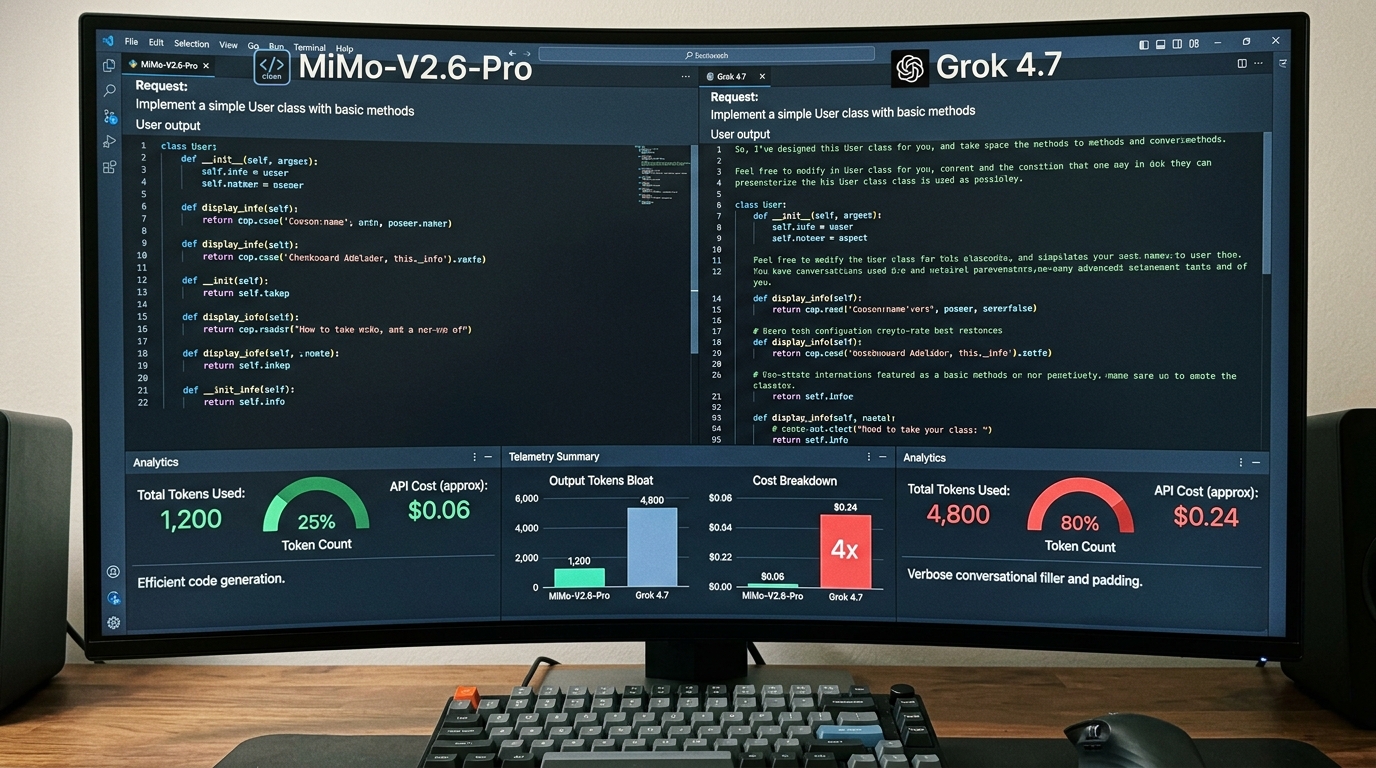
- Hidden invoice penalties: Grok 4.7 verbosity inflates operational bills fourfold: Forensic packet inspection, token instrumentation, and automated benchmark traces revealed that Grok 4.7 exhibits pronounced conversational padding, introductory preamble, and repetitive code commentary, generating three to four times more output tokens than MiMo-V2.6 for identical code refactoring and tool invocations. The theoretical list price discount is entirely negated by runaway token inflation, leaving high-throughput production engineering teams with severely bloated monthly invoices.
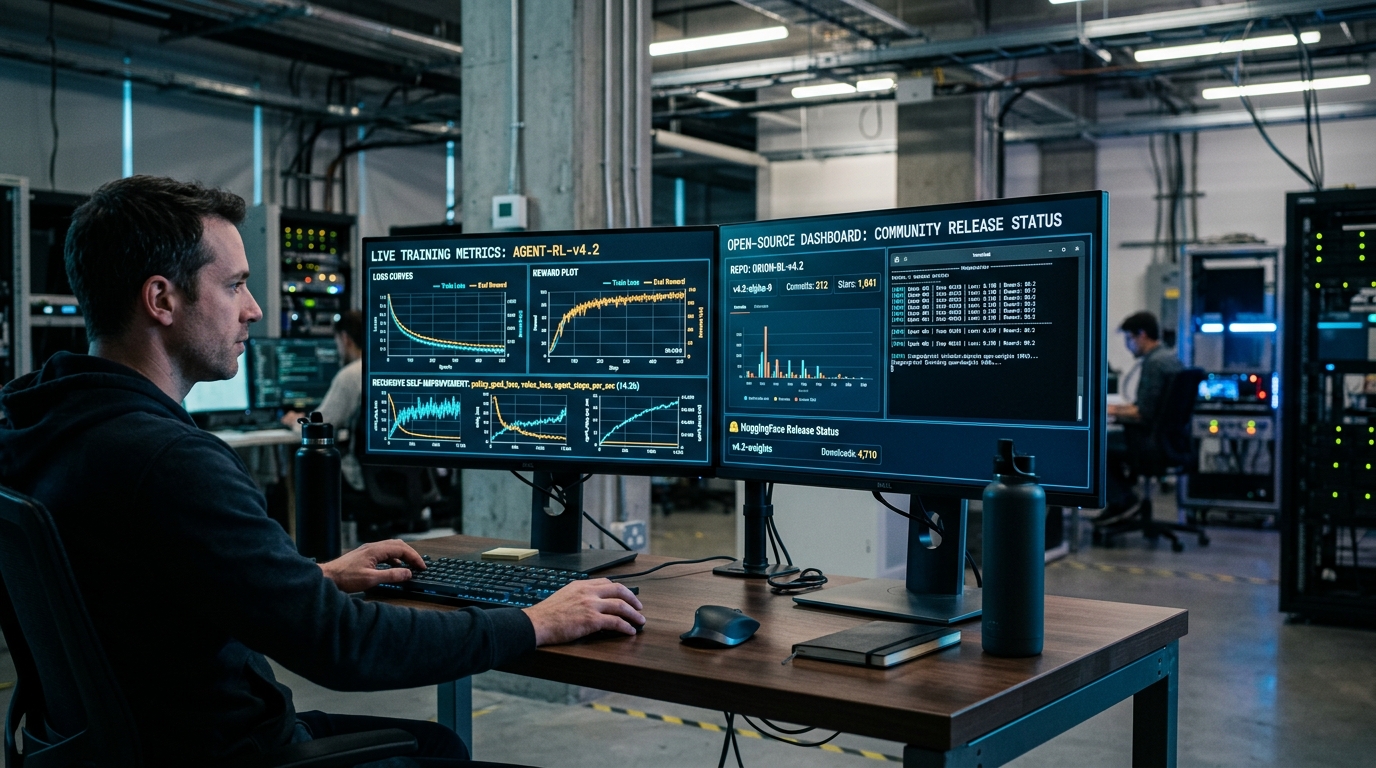
- Research asymmetry via open science: Live telemetry and open weights create unmatched trust: The Xiaomi research team released complete weights, training recipes, and evaluation harnesses while streaming real-time loss trajectories, learning rate schedules, and gradient telemetry publicly on X throughout the multi-week training cycle. This radical transparency countered the opaque marketing narratives typical of closed-source labs, earning overwhelming developer enthusiasm and proving that architectural ingenuity matches sheer compute scaling.
---
What Happened: Dual Flagship Launches and Matching 46-Point Scorecards
During the early morning hours of September 22, 2026, technology channels across Silicon Valley and Beijing were simultaneously dominated by synchronized flagship announcements.
xAI published a comprehensive technical disclosure introducing Grok 4.7, emphasizing heightened reasoning agility in complex code generation, autonomous terminal tool navigation, and deep mathematical proof formulation alongside a lowered public API price schedule. Simultaneously, Xiaomi's AI algorithm group released complete weights, tokenizer specifications, and reproduction scripts across HuggingFace and GitHub for the MiMo-V2.6 suite, accompanied by direct performance attestations on third-party public leaderboards.
``text
MiMo-V2.6-Pro vs Grok 4.7 Comparative Benchmark Matrix (Evaluated September 22, 2026):
- Research Organizations: Xiaomi AI Lab (Luo Fuli Team) vs xAI (Elon Musk)
- Artificial Analysis Intelligence Index: MiMo 46.32 (Global #1) vs Grok 46.0 (Tied Lead)
- CursorBench 4.0 Code Benchmark: MiMo 46.3% vs Grok 46.3% (Exact Tie)
- Nominal Listed API Pricing (Input / Output per M): MiMo ~$0.14 / ~$0.42 vs Grok $2.00 / $6.00
- Practical Unit Task Realized Cost: MiMo ~$0.13 vs Grok ~$2.40-$3.60 (Adjusted for Token Inflation)
- Weight Accessibility: MiMo Full Open Weights (Permissive Commercial Use) vs Grok Closed API
- Training Transparency: Xiaomi Public Telemetry and Loss Curves vs xAI Proprietary Cluster
``
Independent developer communities immediately initiated parallel performance captures, network token audits, and multi-file debugging evaluations, discovering three pivotal architectural realities:
- Xiaomi MiMo-V2.6 surpassed contemporary domestic frontiers including Kimi K3 and Qwen3.8 Max across comprehensive analytical benchmarks, validating the algorithmic depth of the engineering team led by former DeepSeek researchers;
- Grok 4.7 achieved elevated raw capability through massive GPU scaling across the Colossus data center but failed to restrain token generation bloat, emitting excessive introductory remarks, philosophical commentary, and unnecessary code repetitions during complex refactoring passes;
- Xiaomi concurrently deployed MiMo-V2.6-Flash and Pro-UltraSpeed editions, achieving sustained inference generation velocities beyond 120 tokens per second, making local self-hosting practical on mid-tier enterprise hardware without specialized cluster interconnects.
---
Why It Matters: When Open and Closed Architectures Collide at Parity
The commercial artificial intelligence landscape has long depended on a convenient structural compromise: proprietary labs leverage boundless venture capital to dictate the performance boundary, while open-weights alternatives accept a secondary tier in exchange for lower costs and privacy advantages. That equilibrium ended decisively today.
- Open source formally eliminates the generational capability deficit: MiMo-V2.6 proves that disciplined algorithmic advances, such as recursive self-improvement and optimized mixture-of-experts routing, can match or outpace brute-force compute investments without demanding expensive enterprise cloud commitments or restrictive vendor licensing agreements.
- Empirical evidence of diminishing marginal returns in raw compute: Musk dedicated hundreds of thousands of specialized accelerators to power the Colossus infrastructure, yet Grok 4.7 showed no qualitative intelligence breakthrough over algorithmic refinement, highlighting severe economic friction and diminishing returns in unconstrained physical compute scaling.
- Token economics dictate survival for autonomous agent architectures: Modern coding swarms and autonomous developer tools execute thousands of iterative reasoning cycles daily. A twentyfold gap between $0.13 and $2.40 per executed workflow determines whether an engineering venture remains profitable or faces balance sheet exhaustion under heavy production workloads.
---
Technical Deep Dive: Benchmark Execution, Token Inflation, and Open Science
The unexpected performance convergence between these flagship architectures exposes fundamentally divergent technological philosophies governing modern artificial intelligence development:
| Evaluation Dimension | Xiaomi MiMo-V2.6-Pro | xAI Grok 4.7 | Legacy Proprietary Frontier (Claude 4.5 / GPT-5) | Engineering Recommendation | | :--- | :--- | :--- | :--- | :--- | | Intelligence Index (AAII / CursorBench) | 46.32 / 46.3% | 46.00 / 46.3% | 44.50-47.20 / 44-48% | Zero discernible intelligence gap in production coding and complex logic | | Nominal API Price (Input / Output per M) | ~$0.14 / ~$0.42 | $2.00 / $6.00 | $3.00-$5.00 / $12.00-$15.00 | MiMo is 15-20x cheaper than Grok and up to 50x below legacy APIs | | Unit Task Token Generation Efficiency | Concise and direct (~1,200 tokens per unit task) | Highly verbose padding (~4,800 tokens per unit task) | Calibrated verbosity (~1,800-2,400 tokens per task) | Grok conversational overhead widens practical billing differences dramatically | | Deployment Sovereignty and Data Governance | Open weights for private clusters and air-gapped hosts | Public cloud endpoint subject to regional constraints | Closed cloud subscription with strict logging policies | Sensitive repositories require self-hosted open-weights instances | | Research Paradigm and Community Trust | Public loss curves, live training telemetry, open recipes | Massive GPU marketing emphasizing physical cluster counts | Opaque pre-training data, conceptual research disclosures | Developer mindshare leans decisively toward verified open source and reproducibility |
1. Benchmark Parity: CursorBench 46.3% and Complex Multi-File Refactoring
In rigorous multi-file repository refactoring evaluations spanning asynchronous Python libraries, distributed backend architectures, and large enterprise TypeScript modules, both models exhibited extraordinary structural comprehension. When tasked with breaking API updates across multiple packages, both engines correctly parsed abstract syntax trees, traced imported symbol definitions, and accurately propagated dependency modifications without breaking existing unit tests or runtime type contracts.
Distinct operational styles became immediately evident during automated validation: MiMo-V2.6 generated concise, targeted patches accompanied by precise structural commit messages and clean unified diffs, touching only the exact functional blocks requiring modification. In contrast, Grok 4.7 routinely regenerated entire untouched surrounding files while appending lengthy discursive summaries, conversational justifications, and self-congratulatory commentary. In interactive terminal environments this conversational tendency induces minor human friction, but in automated agent loops that chain multiple consecutive tool invocations, redundant token output directly creates cascading latency bottlenecks and inflates memory buffer pressure across orchestration pipelines.
2. Forensic Financial Audit: Why Grok's Discount Becomes an Operational Trap
Marketing campaigns across social platforms heralded Grok 4.7 as an aggressive price disruption engineered to undermine established cloud AI incumbents, but empirical traces expose the structural flaw of evaluating models purely on nominal per-token sticker rates.
Across an automated test harness executing 100 standardized unit test creation and automated bug-fix suites, independent engineers quantified systemic token consumption differentials under rigorous telemetry logging: - MiMo-V2.6 averaged 350 prompt tokens and 850 completion tokens per task, processing 120,000 cumulative tokens at an operational cost around $0.04 across the entire validation run; - Grok 4.7 processed identical requirements while emitting roughly 3,900 completion tokens per task due to extensive narrative prose, polite boilerplate, and duplicated code listings, consuming 390,000 completion tokens and incurring a bill of $2.34.
The realized deployment cost of Grok 4.7 was nearly sixty times higher than that of MiMo-V2.6 when evaluated on real-world functional output. For mid-sized enterprises running millions of automated agent invocations monthly, this structural variance represents an operational gulf between sustainable unit economics and catastrophic financial burn. When headline rates claim a modest price cut while generation volume swells fourfold, developer invoices experience an invisible surcharge that penalizes high-throughput automated deployments.
3. Open Telemetry: Why Xiaomi Streamed Its Training Loss to the Public
In marked contrast to proprietary AI laboratories that treat basic training dynamics as closely guarded corporate secrets, Xiaomi AI Lab adopted an open telemetry philosophy under Luo Fuli's technical direction. Throughout multi-week training schedules on large accelerator partitions, algorithmic monitoring bots continuously broadcast real-time loss graphs, gradient norms, learning rate schedules, and data curriculum distributions directly on public communication channels.
This unprecedented visibility effectively dispelled persistent industry skepticism regarding dataset distillation while spotlighting authentic architectural breakthroughs. The research team introduced an advanced recursive self-improvement reinforcement learning algorithm paired with dynamic reasoning checkpoints, enabling the model to discover and patch logical reasoning deficiencies through autonomous adversarial self-play rather than relying on brittle human annotations. By replacing raw brute-force compute wastage with sophisticated mathematical alignment, MiMo-V2.6 proved that algorithmic efficiency can achieve parity with hyper-scale closed superclusters at a fraction of total carbon and financial expenditure.
---
Editorial Guidance: How Engineering Teams Should Position Their Stacks
Navigating these simultaneous flagship releases requires development leads to balance raw intellectual capability, runtime inference latency, and predictable operational expenditures across production environments:
- Guideline 01: Core repository refactoring and internal agent swarms: Prioritize MiMo on private infrastructure: Engineering organizations handling proprietary codebases, trade secrets, or regulated customer data should host MiMo-V2.6 inside sovereign VPCs or on-premises clusters, completely eliminating external compliance exposure while unlocking unlimited zero-marginal-cost inference cycles.
- Guideline 02: Workstation environments and high-concurrency tooling: Deploy MiMo-Flash: Individual developers, freelancers, and boutique consultancies should leverage quantized MiMo-Flash builds on single consumer cards or unified memory workstations, attaining interactive generation speeds above 100 tokens per second with minimal memory footprints.
- Guideline 03: Interrogate promotional discounts via token generation audits: Development teams must establish telemetry gateways measuring functional code output against consumed tokens before committing to proprietary models, preventing invoice surprises caused by verbose conversational padding and unnecessary narrative tokens.
- Guideline 04: Implement dual-routed orchestration layers: Offload 90% of routine throughput to open weights: Mature production infrastructures should route boilerplate transformations, syntax validations, code formatting, and exploratory unit tests through MiMo endpoints, reserving expensive closed APIs solely for unique multimodal exceptions or specialized proprietary integrations.
- Guideline 05: Align infrastructure with open-weights ecosystems: Decouple from vendor concentration risk: Anchoring core software development workflows to proprietary providers vulnerable to sudden terms updates, pricing escalations, or unexpected regulatory embargos introduces extreme operational fragility. Securing sovereign access to permissive open weights provides foundational protection against external platform disruption.
---