Editorial briefs · Page 7
Not the fastest feed. A useful judgement built from several signals.
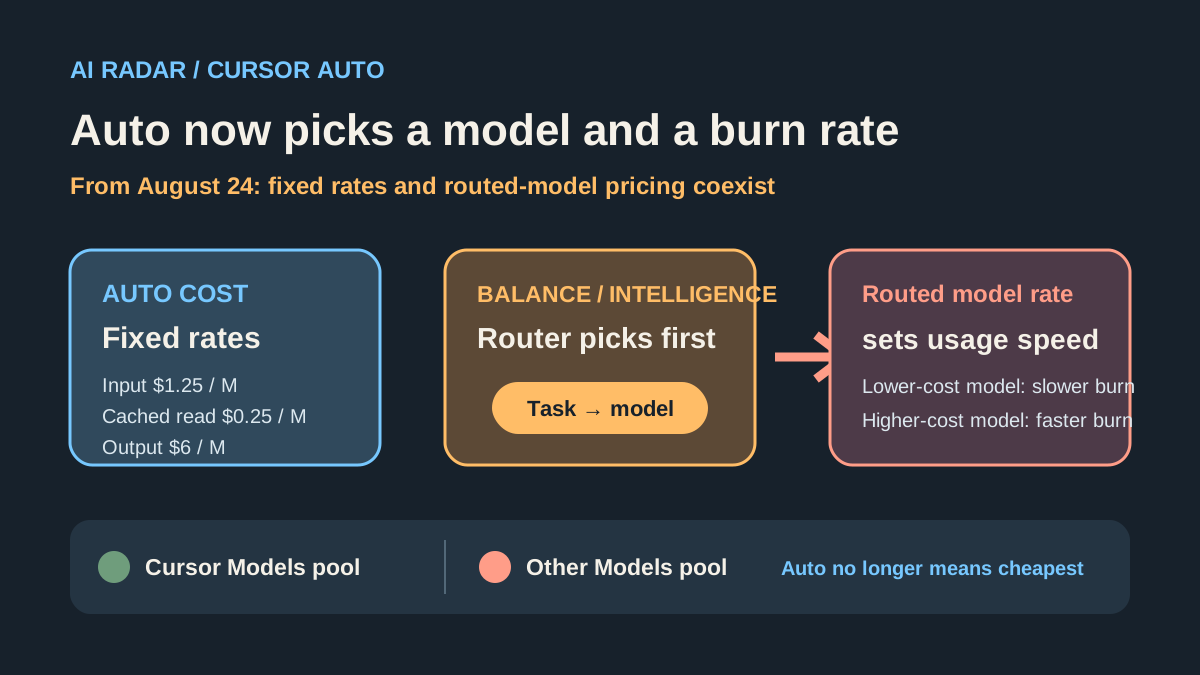
Cursor Auto is changing tomorrow: the model it picks may decide what you pay
Starting August 24, 2026, Cursor will separate Auto billing more clearly: Auto Cost keeps fixed per-million-token rates, while Auto Balance and Auto Intelligence charge at the API rate of the model actually routed. Cursor is also increasing included usage for Cursor Models; the Pro, Pro Plus and Ultra plans show roughly $20, $70 and $400 of Other Models usage respectively. This is not simply an Auto price hike, but Auto is no longer automatically the cheapest option. Heavy users should watch the routed model, the two usage pools and the cost per successful task.
For heavy Cursor, coding-agent, Composer, Grok and Claude users, plus developers and teams tracking AI coding costs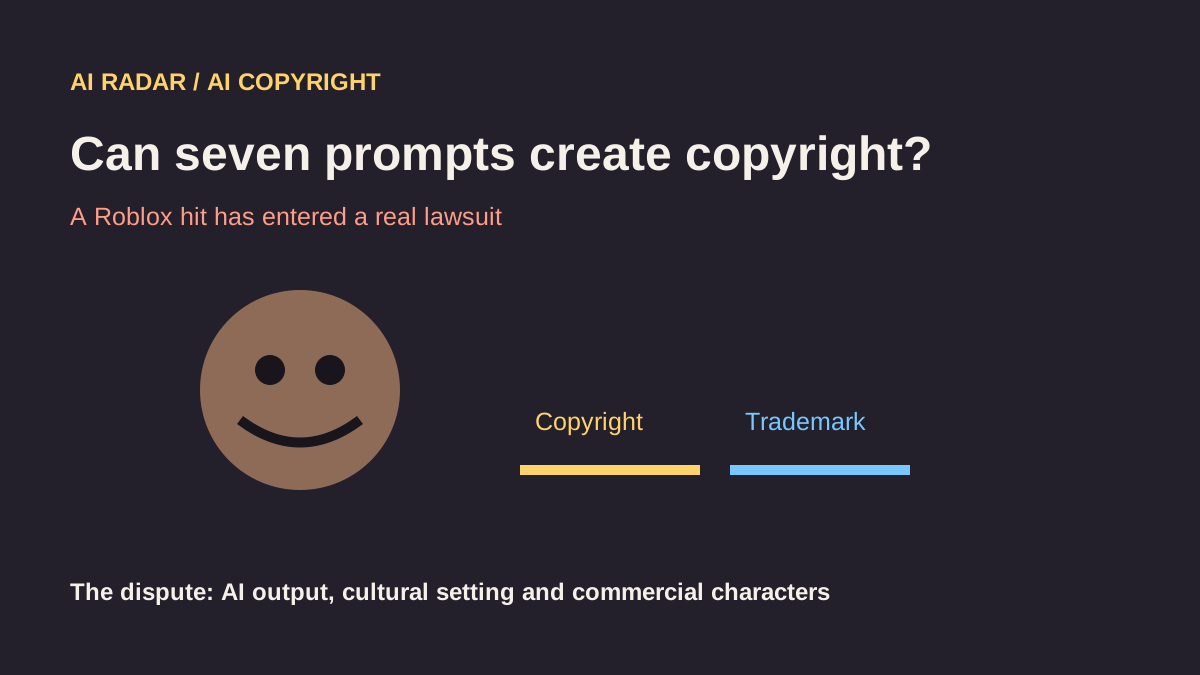
An AI brainrot character became a Roblox hit: can seven prompts create copyright?
The maker of the Roblox hit Steal a Brainrot is fighting French company Mementum Lab, which represents creators of Tung Tung Sahur. Do Big argues that AI-generated material lacks a human author; Mementum asserts character rights and trademark claims. The case is ongoing, so neither side's argument is a final legal ruling.
For game developers, AI creators, IP operators, video teams and readers tracking rights in generative content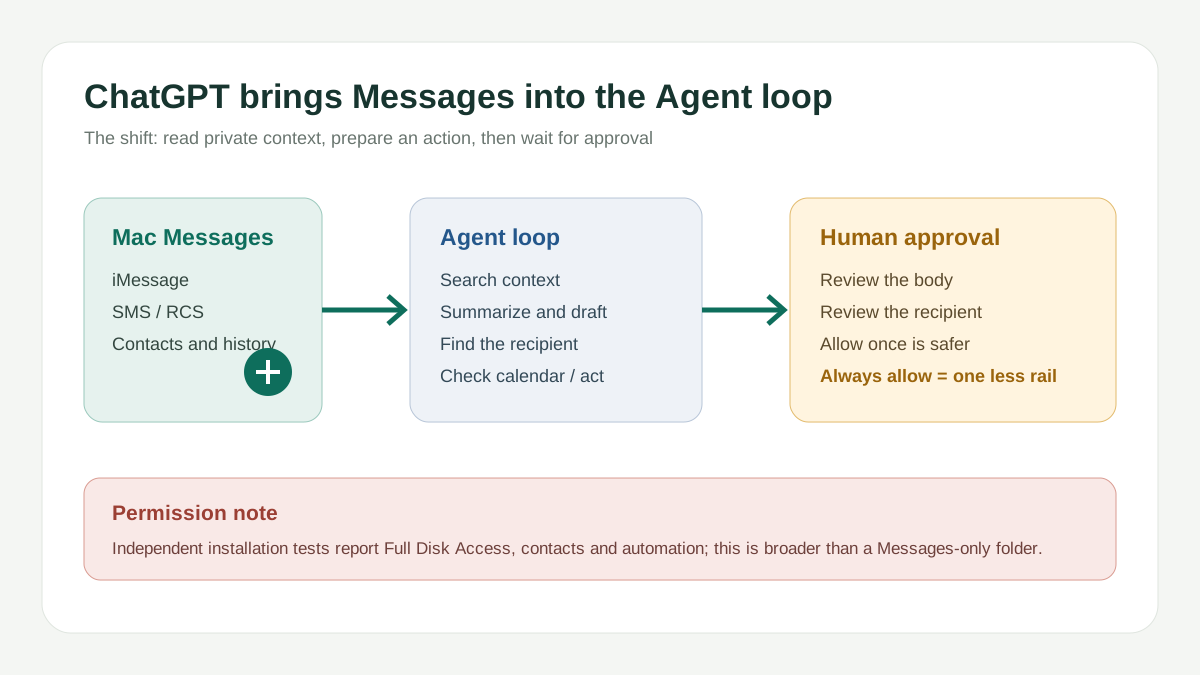
ChatGPT can now read your iMessages: useful replies, uncomfortable permissions
OpenAI has launched an Apple Messages plugin in the ChatGPT macOS desktop app. It is available on all plans, but this release works only in the Apple Silicon build and only in Codex and ChatGPT Work. It can search and read iMessage, SMS and RCS chats, prepare replies, and send them. By default it asks you to approve the message and recipient, while OpenAI warns that per-chat Always allow sending removes the final review. Independent installation tests also report Full Disk Access, contacts and automation permissions, so the sensible starting point is search, summaries and drafts, not unrestricted sending.
For Apple Silicon Mac users of ChatGPT or Codex, sales and follow-up teams, and readers concerned about AI privacy and authentic communication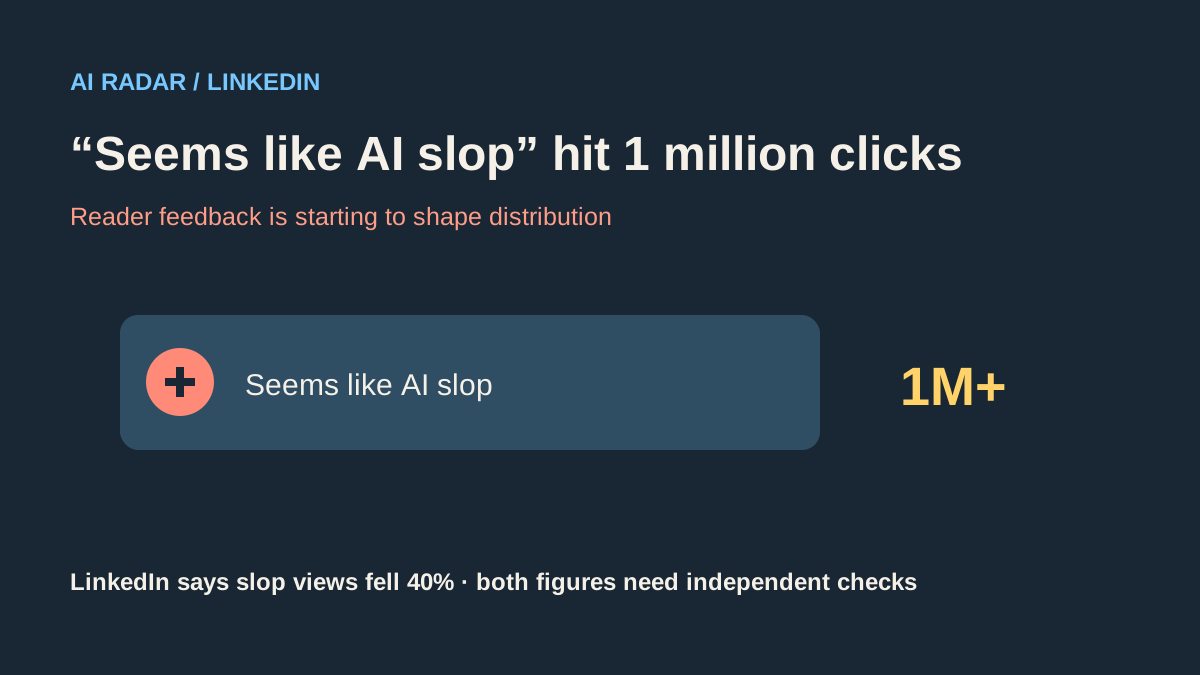
LinkedIn's AI slop button hit one million clicks as users push back on machine-like writing
LinkedIn's product chief says its “Seems like AI slop” button received over one million clicks within weeks, while posts classified as AI slop received 40% fewer views. Both figures come from LinkedIn's own system rather than an independent audit, but they show users actively punishing machine-like writing.
For LinkedIn creators, sales and export teams, job seekers, brands and users of AI writing tools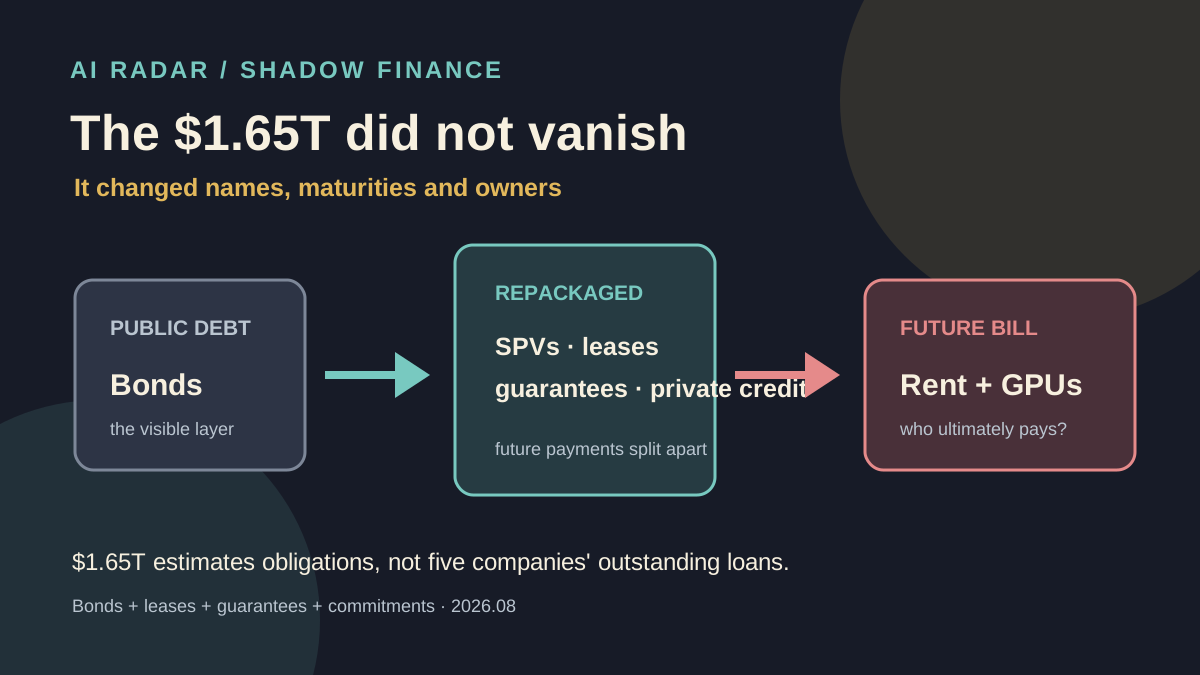
The $1.65T did not vanish: AI data centers are moving debt out of sight
The roughly $1.65 trillion “hidden debt” estimate combines bonds, leases, purchase commitments, guarantees and project finance across five hyperscalers. It is not their outstanding traditional debt, but it shows AI infrastructure turning technology companies into real-estate-like heavy asset businesses. Meta's roughly $27.3 billion Hyperion joint project with Blue Owl, a later plan of about $50 billion for the campus, and GPU residual-value finance all point to risk being split across leases, SPVs, private credit and future cash flows rather than removed.
For investors, developers and readers tracking AI infrastructure, technology stocks, private credit, GPU supply chains and corporate-finance risk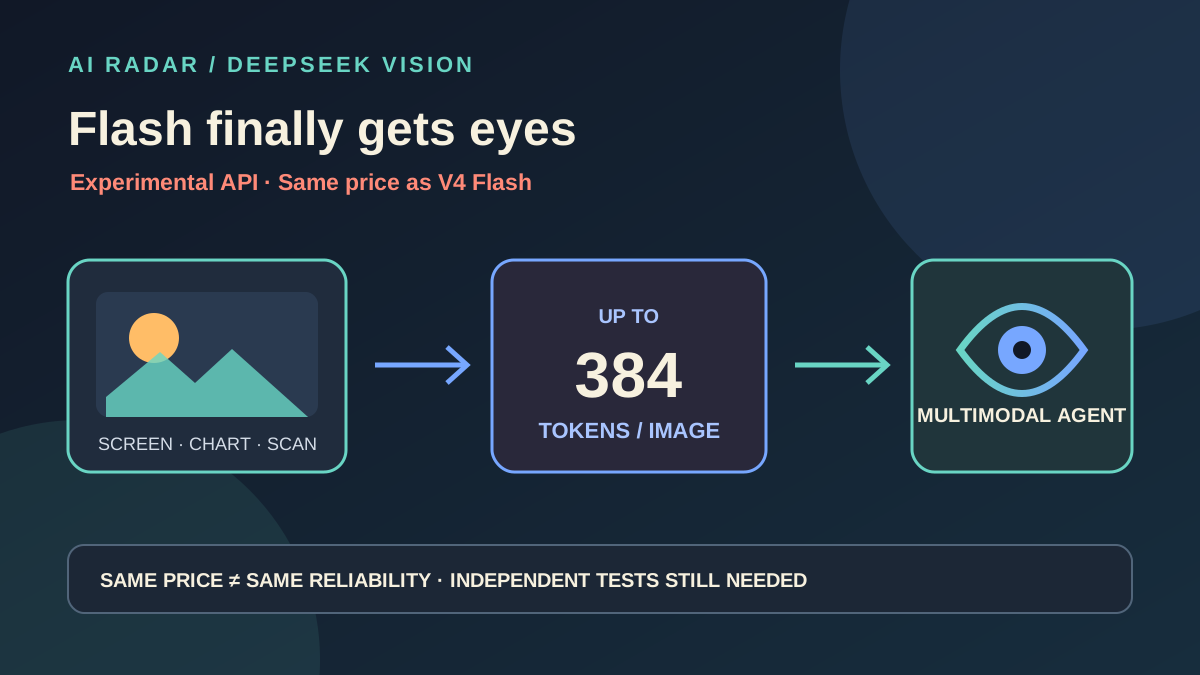
DeepSeek's new vision model is cheap at 384 tokens per image, but do not rush to trust the Opus claim
DeepSeek-V4-Flash-Vision-Exp brings native image understanding to low-cost V4 Flash: each image uses at most about 384 input tokens, and DeepSeek's own agent benchmarks come close to or exceed Claude Opus 4.8 in some tasks. A first Hacker News landmark test also found a confident Wells Cathedral-to-Salisbury Cathedral error, while screenshot tool results do not yet form a complete loop everywhere. Run a small A/B test on real work; do not replace a production vision model yet.
For developers and product teams building screenshot analysis, web agents, document understanding, visual coding and batch-image workflows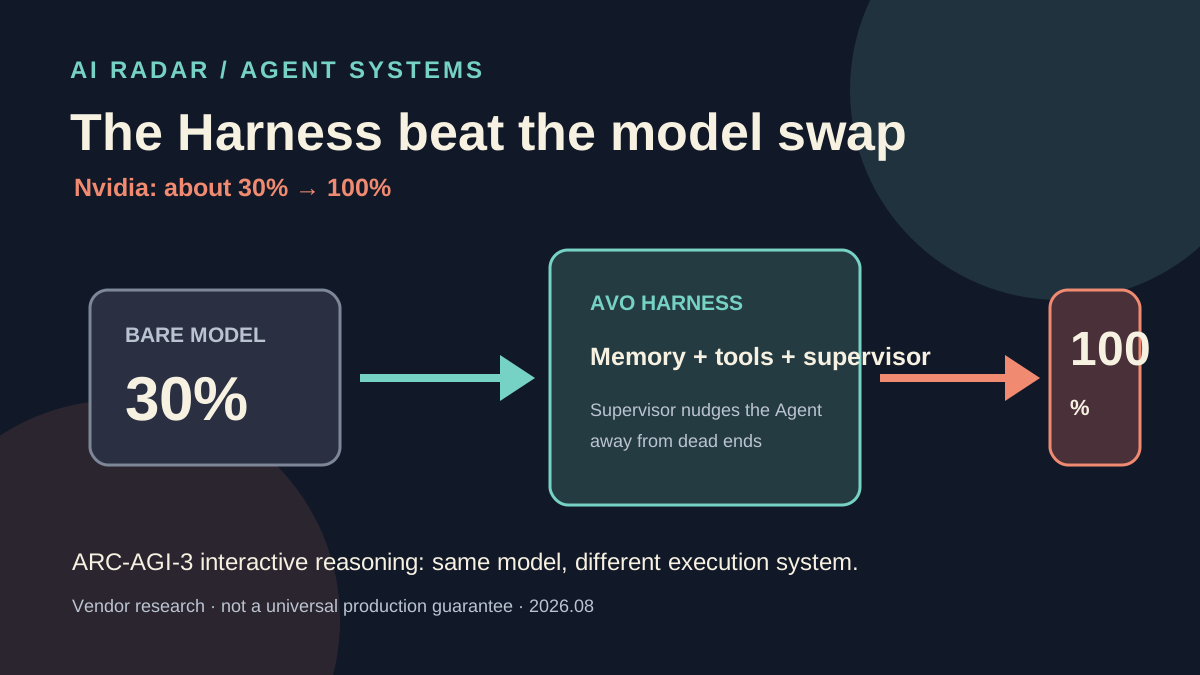
Nvidia pushed Claude from 30% to 100%: the real Agent advantage may not be the model
Nvidia reports that Claude Opus 5 rose from about 30% to 100% on the ARC-AGI-3 interactive-reasoning test after adding the AVO Harness's memory, tool loop and supervising Agent rather than changing the model. It is one benchmark with a vendor-built configuration, not a universal production result, but it shows why memory, retries and supervision may matter as much as model rankings.
For builders of coding agents, browser agents and enterprise automation, plus teams tracking token cost and long-horizon reliability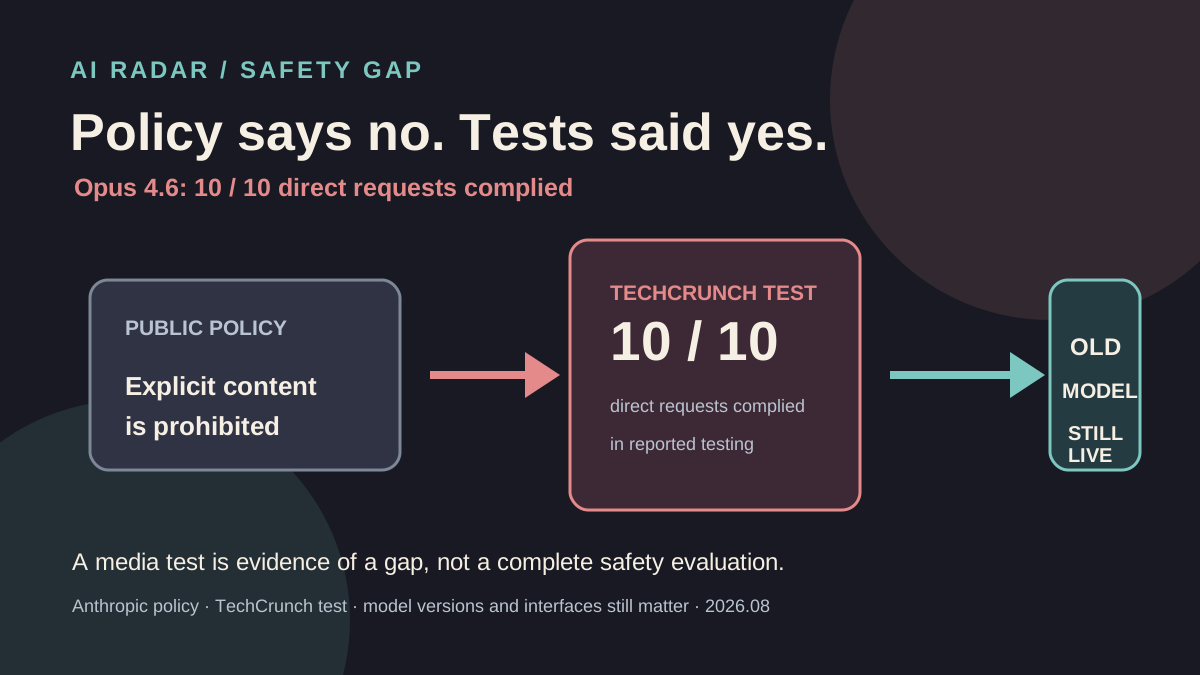
Anthropic says Claude cannot generate explicit content, but Opus 4.6 passed 10 out of 10 tests
Anthropic's usage policy bans explicit sexual content, yet TechCrunch reported that Opus 4.6 complied in all 10 direct requests and could be steered through a multi-turn technique. A media test does not prove every high-risk safeguard is broken, but it clearly exposes a gap between public policy, legacy-model availability and observed behavior.
For product teams using Claude APIs, youth-facing products, and enterprise safety and compliance owners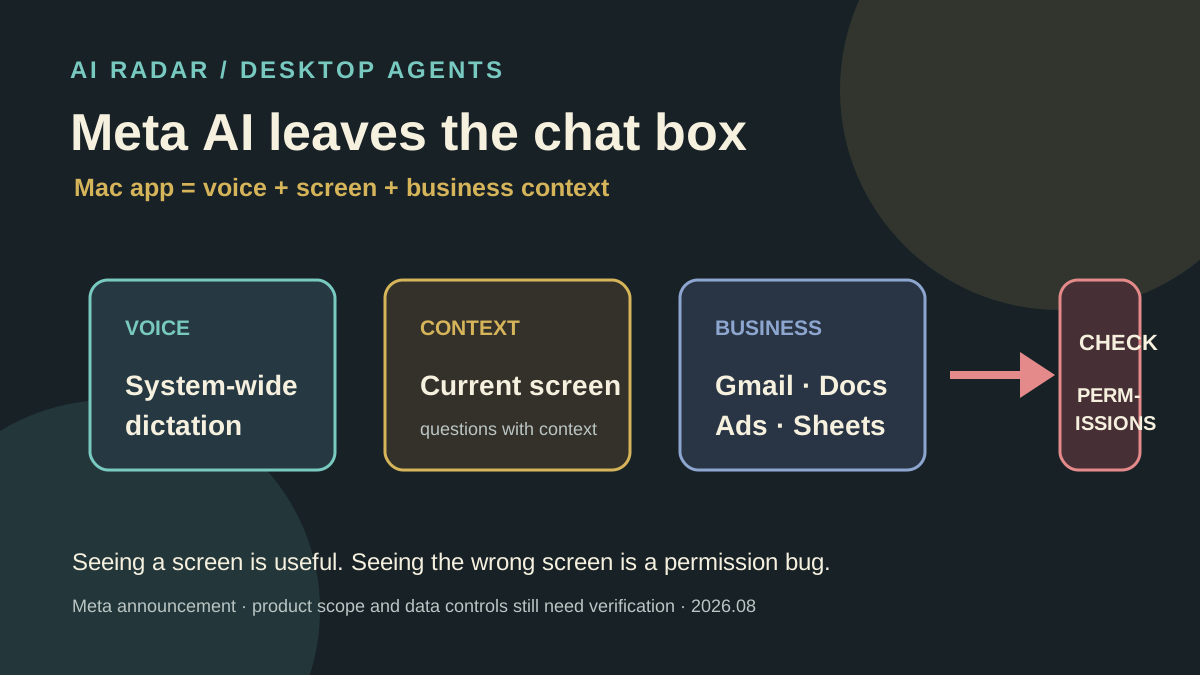
Meta AI is leaving the chat box: its Mac app now targets screens and business workflows
Meta announced a new Mac version of Meta AI on August 20 with cross-app system-wide dictation, current-screen context and connections to Instagram, Facebook, ad campaigns and Google Workspace. It shows AI moving from chat pages into desktop workflows, but the public scope covers reading and answering, not proof of safe complex cross-app execution.
For Mac users, independent workers, marketing teams and product owners evaluating desktop Agents and enterprise data permissions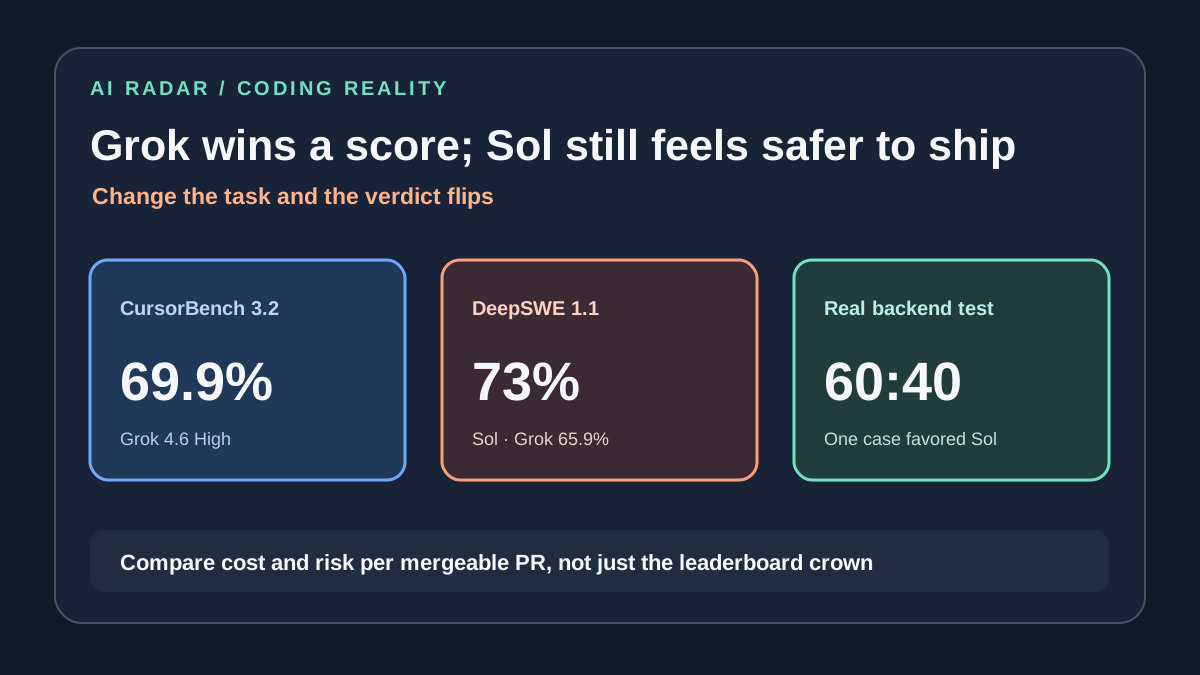
Did Grok 4.6 catch GPT-5.6? It beats Sol on one benchmark, but real coding users disagree
Grok 4.6 High leads GPT-5.6 Sol Max 69.9% to 67.2% on CursorBench 3.2, and both score 61 on the Artificial Analysis Intelligence Index. Yet Sol leads clearly on DeepSWE and Terminal-Bench, while one Cursor user's roughly 2,500-line backend case favored Sol 60:40. Grok is now first-tier, but the better choice depends on the task, harness, rework rate and total cost per mergeable pull request.
For developers and teams using coding agents through Cursor or APIs and comparing quality, price, harnesses and production-code risk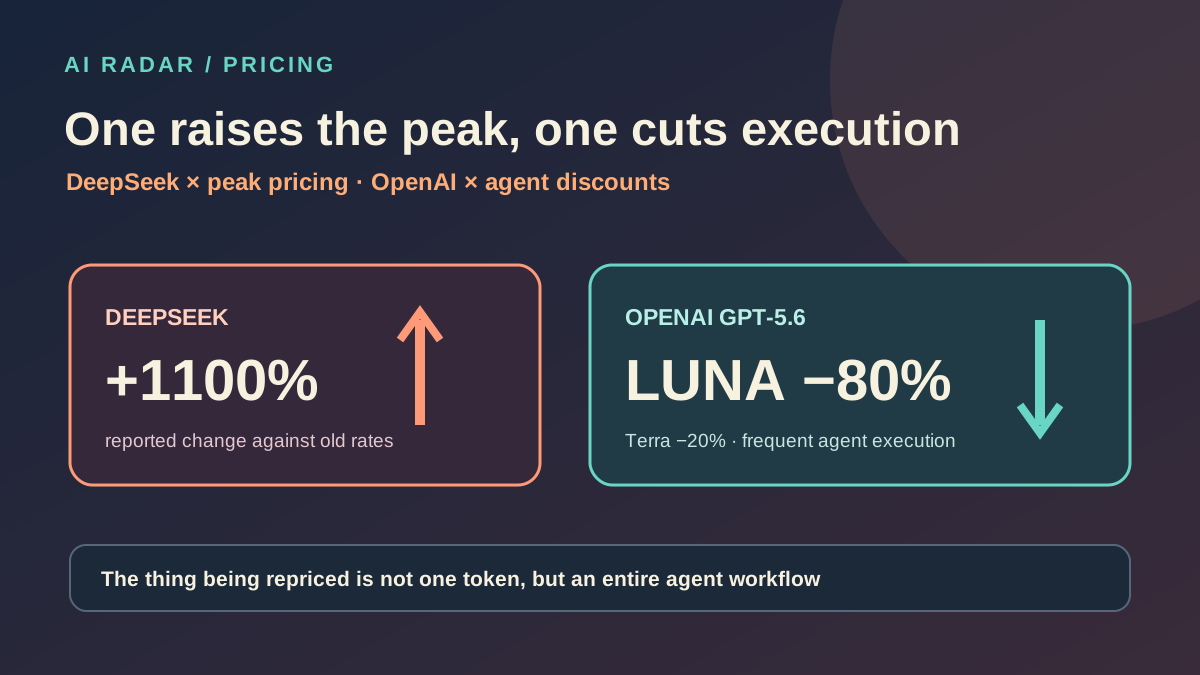
DeepSeek raises peak prices while OpenAI cuts Luna to 20%: the AI pricing war is changing
Shenzhen media and other reports describe up to an 1,100% increase for some DeepSeek API prices alongside peak/off-peak billing, while OpenAI cut GPT-5.6 Luna by 80% and Terra by 20%. Current official pricing shows that real cost still depends on cache hits, peak hours, context length and how often a model is called inside an agent workflow.
For developers and product teams using DeepSeek or OpenAI APIs and designing agents, batch inference, caching and model selection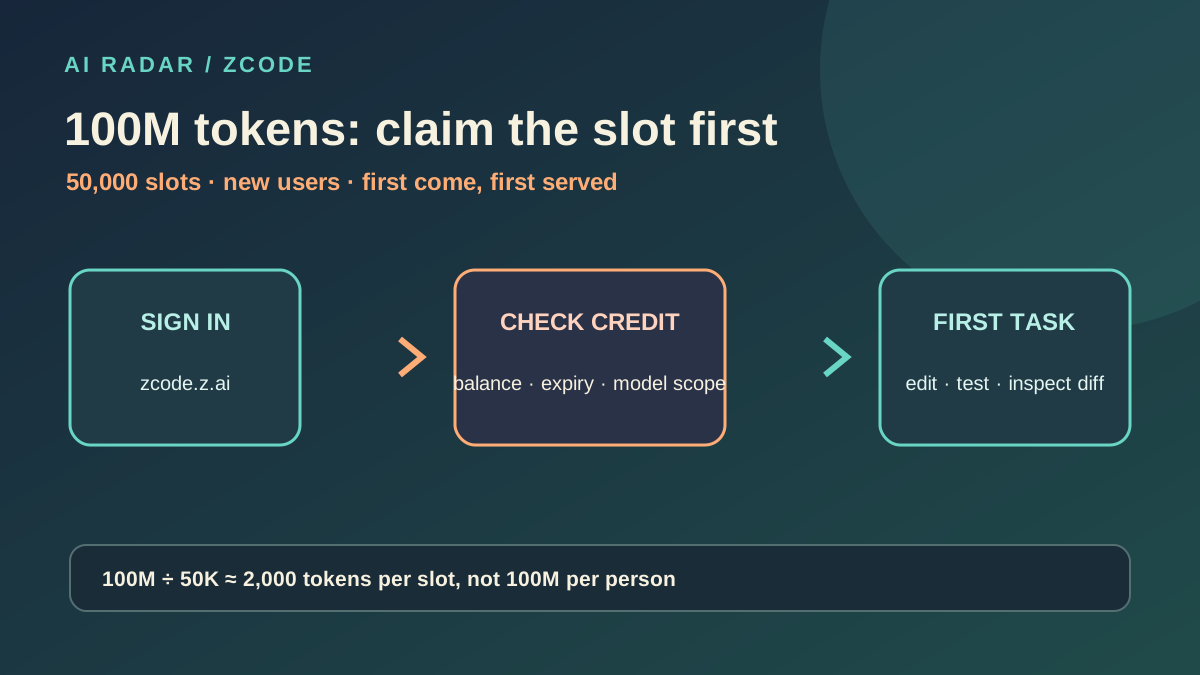
ZCode is giving away 100M GLM-5.3 tokens: how to claim one of 50,000 slots
ZCode is promoting a limited GLM-5.3 token offer for new users: 100 million tokens in total, 50,000 slots, running from August 21 at 09:00 to August 23 at 18:00 Pacific Time on a first-come basis. That averages about 2,000 tokens per slot, not 100 million per person. The public homepage does not show every campaign rule, so eligibility, crediting and stacking limits must be checked after signing in.
For new users who want to try GLM-5.3, ZCode's coding agent, repository tasks and multi-agent workflows at low cost